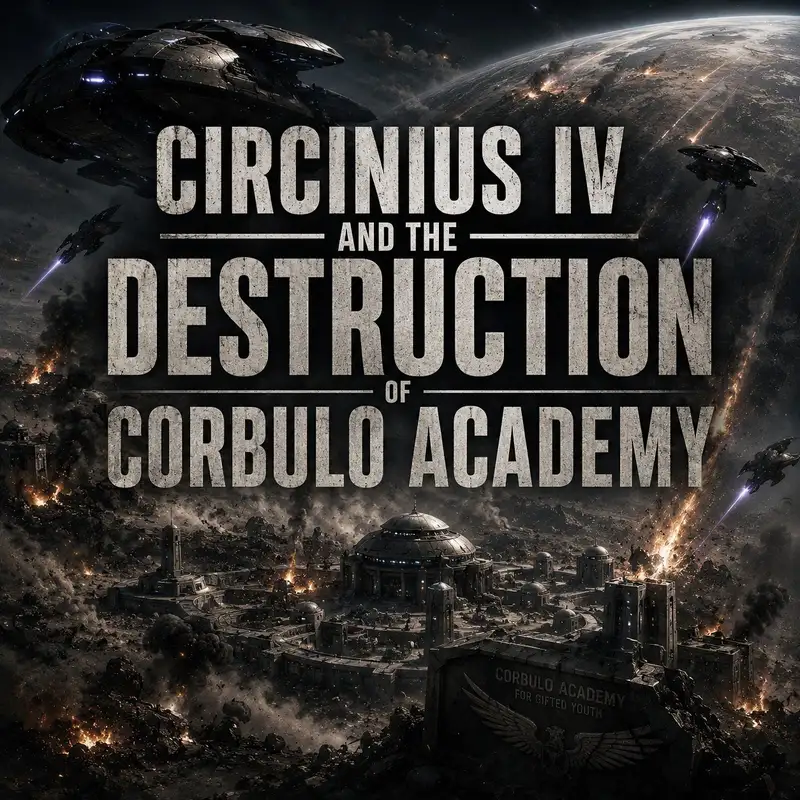
Circinius IV and the Destruction of Corbulo Academy
General Daniel Black had been warned that an alien attack might reach Circinius Four. He was not authorized to explain that threat to most of the people under his command. He could raise the readiness of the Marine garrison, impose communications blackouts, and disguise unusual precautions as routine maintenance. He could not tell hundreds of officer cadets that the war they were training to fight had already been replaced by one their instructors barely understood. When the evacuation order came on April twenty-sixth, twenty-five twenty-six, Corbulo Academy sent its students toward the fastest route off the planet. The space elevator above the campus became the largest concentration of personnel and the most obvious target in sight.
The destruction of Corbulo Academy was not simply a surprise attack on a school. It was an early test of whether the United Nations Space Command could protect its future officer corps while concealing the existence of the Covenant from the public. The answer was severe. Secrecy preserved information control, but denied the academy realistic preparation. Local defenses could fight individual Covenant troops, but could not prevent alien warships from controlling the air and orbit above them. Blue Team could rescue a handful of survivors. It could not restore the evacuation route, rebuild the garrison, or save the colony.
Circinius Four was an Outer Colony administered by the Unified Earth Government. Its forested mountains and river valleys made the region around Corbulo appear more like a remote military campus than a front line. The academy stood on elevated ground among dense woods, with dormitories, lecture halls, training areas, communications arrays, and a central courtyard dominated by an orbital tether. That elevator connected the campus to space and made Corbulo unusually accessible for an institution located far from Earth. It also created a single piece of infrastructure on which evacuation, supply, and reinforcement could all depend.
Corbulo was an officer candidate school rather than a basic-training depot. Many of its students were the children of senior military and government officials, though the cadet body also included people from colonial backgrounds. First-year cadets were generally in their middle teens and expected to complete four years of military education before commissioning into the armed forces. They studied tactics, military history, weapons, leadership, and the physical disciplines required of future officers. The academy was designed to produce people who would command ships, ground units, aerospace forces, and support organizations. It was an investment in the next generation of the state’s military leadership.
That investment carried a political message. Corbulo’s architecture and instruction emphasized duty to Earth and the United Nations Space Command at a time when the Insurrection had divided human space. Cadets lived beneath slogans about service, continuity, and sacrifice. They trained against human opponents because human rebellion was the war the institution understood. The academy’s curriculum taught them how to defeat ambushes, control terrain, follow a chain of command, and suppress armed resistance. None of those skills was useless against the Covenant. None prepared them for a warship nearly a kilometer long descending through the clouds and destroying their route to orbit.
The cadets of Hastati Squad represented the academy’s strengths and contradictions. Senior Cadet April Orenski was responsible for a group that included Thomas Lasky, Chyler Silva, Michael Sullivan, Walter Vickers, Junjie Chen, Dimah Tchakova, and others. They were intelligent, competitive, and still learning how much individual judgment could be tolerated inside a military system. Their training disputes concerned human-scale problems: whether Lasky should follow a flawed plan, whether the squad should accept penalties for one member’s choices, and whether family expectation was a sufficient reason to serve.
Lasky was the most reluctant of them. His mother, Audrey Lasky, was a senior officer. His older brother Cadmon had served as an Orbital Drop Shock Trooper and had already been killed in the Insurrection. Thomas possessed tactical ability but distrusted the institution trying to shape him. A serious medical reaction during training offered a possible discharge just as he was beginning to understand that his doubts did not excuse abandoning his squad. His conflict was not cowardice against courage. It was the question of whether service chosen under family and institutional pressure could ever become his own.
Michael Sullivan had begun uncovering evidence that the official war picture was incomplete. He accessed classified combat imagery showing United Nations Space Command troops, Insurrectionists, and armored Spartans apparently fighting a common enemy. The footage lacked enough context to reveal the Covenant, but it contradicted everything the cadets had been told about the conflict. The academy was teaching future officers to interpret intelligence while denying them the most important intelligence available. That was not accidental. Office of Naval Intelligence Section Two was still attempting to control public knowledge of the alien war.
The arrangement resembled an early application of Winter Contingency, the emergency framework used when a colony faced a threat whose disclosure could compromise wider security. In theory, compartmentalization prevented panic and protected operations. At Corbulo, it split responsibility from knowledge. Black carried enough information to fear an attack, the Marines carried enough authority to tighten security, and the cadets carried the obligation to obey. Almost no one possessed all three. The system was designed to prevent uncontrolled reaction. It also prevented the people nearest the danger from making informed preparations for it.
The secrecy had an operational purpose. News that an unknown empire had destroyed Harvest and defeated human warships could produce panic, economic disruption, uncontrolled evacuations, and political instability across the colonies. It could also provide Insurrectionist groups with evidence that the central government had concealed an extinction-level threat. Information control bought time for mobilization. It also ensured that many units and civilians encountered the Covenant without understanding the enemy’s weapons, doctrine, species, or objective. Corbulo became one of the places where that trade failed visibly.
General Black knew enough to take precautions. He increased the readiness of the Marine garrison and authorized communications interruptions under harmless explanations. Those measures may have reduced the delay between the first alarm and armed response. They did not allow the academy to disperse its cadets, harden shelters, pre-position evacuation transports, or conduct realistic drills against orbital attack. A warning that cannot be shared is useful mainly to the small number of people cleared to worry about it.
The attack began with speed. At least three Covenant heavy corvettes descended into the atmosphere above Corbulo while a larger alien force controlled the system. The academy’s alarm moved cadets and staff toward the orbital tether. Marines established security and attempted to load elevator cars. Orbital Drop Shock Troopers descended onto the campus as reinforcement. For a few moments, the United Nations Space Command was performing the evacuation its infrastructure had been built to support.
Then a Covenant corvette fired on the elevator.
The strike destroyed the ascending car and severed the tether. Sections of the structure collapsed across the academy, killing cadets, staff, and defenders who had gathered beneath it. Dimah Tchakova had used her mother’s Fleet Command position to gain early access to an elevator car. The privilege placed her directly inside the target. Others died while waiting for the same route. The academy had concentrated people for efficient movement, and the Covenant turned efficiency into vulnerability.
The loss of the tether changed the battle immediately. Corbulo no longer possessed a mass evacuation route. Any surviving aircraft had to operate beneath Covenant warships and ground forces. The collapse damaged the campus, divided units, blocked movement, and disrupted command. Personnel who had assembled for evacuation now had to find cover inside a facility never intended to withstand sustained alien attack. The school’s most spectacular piece of infrastructure became the mechanism of its destruction.
Marines and Orbital Drop Shock Troopers fought across the campus, but their reinforcement did not solve the decisive problem above them. Ground troops can protect a landing zone, hold a corridor, and delay an assault. They cannot prevent an enemy corvette from firing into the facility unless friendly naval or aerospace forces can contest the sky. The defenders were fighting beneath an opponent that selected where to land troops, where to fire, and when to withdraw. Corbulo’s garrison could impose casualties. It could not regain operational control.
General Black was killed early. Colonel Kennedy Mehaffey attempted to organize surviving cadets and move them through service tunnels, but Covenant troops had already penetrated the academy. Sangheili warriors and Kig-Yar marksmen moved through buildings and courtyards while the human command structure collapsed. The cadets encountered weapons they had never seen and opponents whose physical size, armor, and energy shields invalidated many assumptions built into their training exercises.
The attack inside the academy was not a contest between prepared formations. It was a sequence of local groups trying to understand a battlefield after communications, leadership, and evacuation had failed. Some cadets followed instructors. Others became separated in smoke and debris. Members of Hastati Squad died while moving between dormitories, tunnels, and weapons areas. Junjie Chen was killed by a Sangheili Zealot. Walter Vickers tried to draw the attacker away from the remaining cadets and was killed in the attempt. Their training provided enough discipline to act. It could not make the action successful against an enemy they could barely injure.
Lasky, Orenski, Silva, and Sullivan reached an armory area and attempted to send a distress call. The beacon was unreliable, and the cadets could not access the live ammunition secured inside the weapons lockers. This was a sound peacetime control measure. Officer candidates should not normally have unrestricted access to operational ammunition. Under alien assault, the same safeguard left four survivors inside an armory with training weapons and a locked supply of the items most likely to keep them alive.
The Sangheili Zealot reached them before help did. Its energy sword cut through doors and walls that had provided protection against small-arms fire. The cadets had no practical means of stopping it. John One One Seven entered the room and killed the Zealot at close range. The rescue was so sudden that the survivors initially had difficulty understanding what had happened. They had seen fragmentary footage of armored figures. Now one stood in front of them, carrying the war the government had concealed.
John was operating as part of Blue Team, with Kelly Zero Eight Seven and Frederic One Zero Four involved in the wider extraction effort. The Spartans had been redirected from counterinsurgency to Covenant combat only months earlier. Their Mjolnir Mark Four armor had no energy shields, but it gave them the strength, protection, sensors, and mobility required to fight Covenant troops on more equal terms. Corbulo showed what that capability meant at the smallest useful scale. One Spartan could eliminate the enemy that had trapped four cadets. The academy around him continued to fall.
John opened the secured weapons lockers and armed the survivors. He did not attempt to retake the campus. That distinction matters. A rescue force must remain focused on extraction when the defended position has already become untenable. Every additional room cleared would consume ammunition and time while Covenant ships remained overhead. The objective was no longer Corbulo Academy. It was the survival of the people still able to move.
Outside, Kig-Yar fire wounded Sullivan and forced the group to fight through the remains of the campus. John secured General Black’s Warthog, and the survivors drove into the forest toward a Pelican rendezvous. The vehicle offered speed and a heavy weapon, but the road network also created predictable lines of movement. Covenant troops fired from the trees and eventually forced the group to abandon the damaged Warthog. What remained of the rescue continued on foot.
Chyler Silva had been struck by a needler round during the escape. The wound worsened after the group entered the forest. She gave Lasky her identification tags before dying. Her death reduced the academy’s surviving cadets from four to three and changed the meaning of Lasky’s decision to remain with the group. He had entered Corbulo uncertain whether he belonged in military service. He left carrying the tags of someone who had chosen that service and had not been given time to complete it.
Two Mgalekgolo blocked the route to extraction. These were not merely large infantrymen. Each armored form was composed of a colony of Lekgolo organisms working as one combat body, protected by heavy armor and carrying a weapon capable of destroying the cadets with a single accurate shot. John expended his remaining ammunition killing one and was left with a grenade against the other. Mjolnir made him capable of engaging it. The suit did not provide unlimited ammunition, an especially inconvenient omission in any weapons system advertised as decisive.
Lasky volunteered to draw the second Mgalekgolo’s attention. The choice gave John the opening required to close the distance and place the grenade beneath its armor. Lasky was not transformed into a Spartan by courage, and the action did not make the cadets equal participants in firepower. It showed that tactical usefulness depends on timing and judgment as much as physical capability. The least powerful person in the engagement created the opportunity the most capable person needed.
The survivors reached the Pelican as Covenant forces began burning the region from above. Kelly and Fred were waiting with the extraction craft. John told the cadets that they were the only survivors on the planet. In the immediate context, that was the information available to his team and the people it had located. Later records complicate the statement. Circinius Four was only partially glassed, and subsequent operations indicate that other civilians may have survived elsewhere or been recovered later. The scene still captures the truth of Corbulo. Of the academy group that entered the attack, only Lasky, Orenski, and Sullivan escaped with Blue Team.
The destruction was a Covenant victory. Corbulo’s cadet corps, staff, Marine garrison, and responding Orbital Drop Shock Troopers were almost entirely lost. The academy was ruined, its orbital tether destroyed, and the surrounding region subjected to plasma bombardment. The Covenant apparently left much of Circinius Four intact, possibly because something on the planet remained valuable, though the surviving record does not establish the reason clearly enough to pretend certainty.
Corbulo failed so quickly because its defenses were built around the wrong war and concentrated around infrastructure the enemy could destroy from the air. The cadets had been trained to become officers in a conflict against human separatists. Their leaders possessed only partial information about the Covenant. The garrison lacked the naval power required to protect the tether. Reinforcements arrived directly into a battle whose orbital conditions they could not change. Once the elevator fell, evacuation became a small-unit escape rather than a planetary movement.
The secrecy surrounding the Covenant made each weakness worse. Had every cadet known the truth, the academy still could not have defeated the corvettes. Better information would not have created orbital guns or a relief fleet. It could have produced dispersion, hardened positions, alternate routes, live-ammunition procedures, and drills based on the enemy actually approaching. Information does not stop plasma. It does determine whether people are standing beneath the target when the first shot arrives.
The battle also demonstrated the proper and improper scale of Spartan power. John saved four cadets from the Zealot, led them through Covenant positions, defeated two Mgalekgolo with help from Lasky, and delivered three survivors to extraction. Those were extraordinary tactical effects. Blue Team did not save Corbulo Academy or Circinius Four. Spartans could create openings, recover intelligence, and preserve selected personnel. They could not provide orbital control, mass transportation, medical capacity, or the thousands of conventional troops required to defend a colony.
For the survivors, Corbulo did not end at the Pelican ramp. Orenski continued her military education. Sullivan later entered Office of Naval Intelligence, eventually serving inside the organization whose information controls had shaped the academy’s unpreparedness. Lasky remained in service, became a naval officer, and rose to command responsibilities aboard the United Nations Space Command Infinity. His later willingness to support John on Requiem was not based on legend alone. It came from remembering the teenager in armor who had entered a locked room when every formal defense around it had failed.
The academy’s destruction also became part of the institutional memory of the war. It showed that officer schools, family connections, and proximity to senior command did not make anyone safe. The Covenant did not distinguish between the children of admirals, colonists from Harvest, Marine defenders, or medical personnel. The attack destroyed a place designed to reproduce military authority across generations. In that sense, Corbulo was both a tactical target and a warning about the future. Humanity’s existing officer corps was fighting a war for which its replacements had not been prepared.
Postwar efforts eventually began deglassing parts of Circinius Four and rebuilding Corbulo. Reconstruction could restore classrooms, training grounds, and an academy bearing the same name. It could not reproduce the cadet class that stood beneath the tether in twenty-five twenty-six. Military institutions often rebuild facilities because continuity matters. The new walls also become evidence that continuity had to be manufactured after the original institution failed.
The defining image is the academy’s orbital tether falling through the campus while cadets trained for one war watched another descend from the clouds. Corbulo was destroyed by Covenant firepower, but its vulnerability had been created by secrecy, concentrated infrastructure, and a defense plan without control of orbit. Blue Team carried three future officers away from Circinius Four. The academy had been built to prepare an entire generation to command humanity’s wars. Its final contribution was teaching the survivors how quickly command, doctrine, and prestige become irrelevant when the enemy controls the sky.