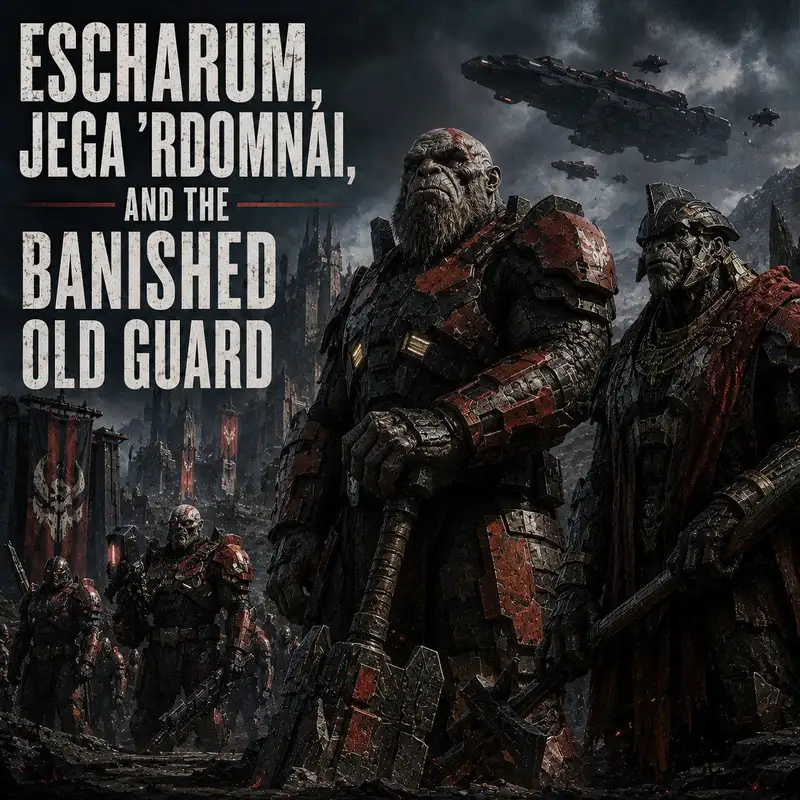
Escharum, Jega ’Rdomnai, and the Banished Old Guard
Jega ’Rdomnai stood beside Escharum’s body on the roof of the House of Reckoning while the surviving Banished commanders gathered below. It was June fourth, twenty-five sixty, five days after John One One Seven had mortally wounded the old war chief. The funeral should have demonstrated continuity. Instead, chieftains and warlords began arguing over who would inherit command. Jega killed one challenger, took a human prisoner, and departed before the gathering became a succession battle. The old guard had lost its center.
That scene explains why Escharum and Jega mattered to the Banished. Neither was simply another officer serving beneath Atriox. Escharum had helped form the thinking that made rebellion possible. Jega embodied the movement’s rejection of Covenant custom at the level of the individual warrior. Together, they carried memory, authority, and personal trust across species lines that the Covenant had spent generations keeping hostile. Their strength helped the Banished survive. Their methods also ensured that succession would remain personal, violent, and uncertain.
The phrase Banished old guard does not describe a formal council or military branch. It is a useful label for the veterans whose authority came from proximity to Atriox’s revolt and from surviving the Covenant system that revolt rejected. Decimus stood beside Atriox during the first uprising and became his principal lieutenant. Escharum had been Atriox’s mentor before that uprising. Other commanders, shipmasters, assassins, and clan leaders joined as the movement expanded. What distinguished the old guard was not age alone. It was shared ownership of the founding story.
Escharum had been born on Doisac in twenty-four seventy-one, into a civilization still carrying the damage of the Great Immolation. Jiralhanae nuclear war had reduced their technological base before the Covenant incorporated them. As a young adult, Escharum witnessed a new empire offer ships, weapons, and access to the stars while preserving control in San’Shyuum hands and senior fleet authority in Sangheili hands. The Jiralhanae were elevated enough to fight interstellar wars and restricted enough to remain dependent.
He became a daskalo, a mentor and military teacher, to Atriox during the Human-Covenant War. The surviving record does not present Escharum as the sole author of Atriox’s rebellion. It does establish that Atriox sought his counsel and that Escharum encouraged him to break from the Covenant. That advice carried unusual weight because it came from an older warrior who understood both Jiralhanae custom and the institutional machinery spending their lives.
Covenant commanders repeatedly used Atriox and his pack in assaults with catastrophic casualty expectations. Religious doctrine described survival as proof of divine purpose and death as sacrifice on the path to transcendence. Escharum saw the arrangement more materially. The Prophets possessed authority. The Sangheili issued orders. Jiralhanae bodies absorbed the cost. His answer was not pacifism or political equality. It was the belief that strength, knowledge, industry, and weaponry should belong to those willing to seize and use them.
That belief became part of Banished culture after Atriox’s revolt. The movement did not promise universal freedom. It promised freedom from service to the Covenant and opportunity beneath a different hierarchy. Loyalty could be earned through capability rather than species rank. Captured supplies could become a logistical base. A useful enemy could become an ally. A failed commander could become an example, often for the brief period between judgment and execution.
Escharum later expressed that philosophy through his contempt for hope. To him, hope was sentimental language used by the weak when they lacked food, factories, weapons, or the ability to impose a decision. His gravity axe was named Diminisher of Hope because psychological defeat was part of the weapon’s intended effect. The analysis contained a hard truth and a deliberate blind spot. Material power sustains armies. Hope influences whether people continue fighting after the material situation says they should stop.
Escharum was well suited to preserving that system when Atriox was elsewhere. He understood clan politics, religious factions, and the difference between offering autonomy and surrendering control. When Castor and the Keepers of the One Freedom joined the Banished, Escharum assigned the Sangheili blademaster Inslaan ’Gadogai as adviser, representative, and potential executioner. The arrangement gave Castor access to Banished power while ensuring that betrayal had a witness standing nearby with an energy sword.
He also accepted recruits the Covenant would have treated as politically unusable. When the New Colonial Alliance offered its personnel, intelligence, and resources, Escharum allowed the human insurgent Ilsa Zane to prove herself by killing the organization’s founder and taking command. This was not tolerance in the humanitarian sense. Escharum disliked humanity and later became openly genocidal toward it. He could still recognize that a human Spartan, a rebel network, or a captured industrial asset might be useful before hatred demanded a different calculation.
Jega ’Rdomnai entered Escharum’s life from the other side of the Covenant hierarchy. He was a Sangheili blademaster and a member of the Silent Shadow, the Covenant’s feared special-operations assassins. His work required active camouflage, patient observation, close-range violence, and the confidence to strike personnel who believed their security arrangements were adequate. Like most statements involving elite assassins, adequate was usually a temporary description.
On the moon Rangiren, Jega led a Silent Shadow team against Spartan Three Headhunters Jonah B Two Eight Three and Roland B Two One Zero. The Spartans had infiltrated a Covenant installation and prepared demolition charges. Jega’s team ambushed them and killed Roland, but Jonah detonated the site rather than permit capture. The explosion destroyed the other Silent Shadow operatives and left Jega without his left arm and part of his left mandibles.
Sangheili tradition placed severe stigma on disfigurement, dependence, and mechanical replacement of the body. Other Sangheili counseled Jega to die rather than continue in what they considered dishonor. Escharum chose the opposite interpretation. He saw a warrior whose rage had survived what should have killed him. The Banished rescued Jega, supported his reconstruction, and treated his refusal to die as an asset instead of a shame.
Jega accepted prosthetic mandibles, a cybernetic arm, internal replacements, and medical technology that Covenant custom would have condemned. The damaged hilt of his energy sword was reforged into Ghostpierce, a weapon integrated with the mechanical limb. He kept a charred blade recovered from Jonah as a reminder of Rangiren. The result was not simply a wounded Sangheili restored to duty. It was a warrior who had severed his relationship with the culture that once defined what survival was allowed to look like.
Escharum and Jega developed a friendship rare between their species. That relationship did not emerge from reconciliation between Sangheili and Jiralhanae society. It emerged because each recognized something the Covenant had tried to suppress. Escharum saw a disciplined killer whose value exceeded old caste rules. Jega saw a commander who did not demand death as payment for disfigurement. Their loyalty was personal, not diplomatic, and it became stronger than the inherited rivalry around them.
The scars across Escharum’s face became part of that shared history. During an early encounter, a beast tore across his right eye and face, and the incident helped turn mutual respect between the two warriors into friendship. Banished relationships were often built through survived danger rather than ceremony or negotiation. The bond between war chief and blademaster was unusual because it continued after the danger ended, giving each a confidant from the species Covenant politics had taught him to distrust.
Jega eventually became the first recruit associated with the Hand of Atriox, an elite Banished formation whose members competed for prestige through difficult missions and the destruction of exceptional enemies. Within Escharum’s command, Jega served as blademaster, hunter, and enforcer. His active camouflage and bloodblades made him dangerous in a duel. His greater value came from reconnaissance, stalking, intimidation, and the ability to remove commanders before a larger force understood it was under attack.
This relationship shows what the Banished old guard did better than the Covenant. The Covenant assigned authority through species, office, faith, and patronage. The Banished could place a Sangheili assassin beside a Jiralhanae war chief because both were useful and personally loyal. That flexibility expanded recruitment and allowed commanders to build mixed forces around missions rather than inherited rank. It also made the organization dependent on the judgment of powerful individuals. When trust failed, there was rarely a neutral institution available to settle the dispute.
Different old-guard figures supplied different functions. Decimus represented direct command, extraction, and overwhelming force. Escharum managed coalitions, discipline, recruitment, and ideological continuity. Jega supplied selective violence against the people most capable of disrupting those systems. Atriox stood above them as founder and final political authority. The structure was effective while those relationships remained intact. It became far less clear once distance, death, and competing theaters removed the personalities that connected one part to another.
In twenty-five fifty-eight, Atriox and Decimus departed for the Ark aboard the assault carrier Enduring Conviction. Escharum remained in the galaxy and held authority over the forces they left behind. After Decimus died on the Ark, Escharum became Atriox’s principal deputy. The arrangement required him to manage a confederation spread across systems, composed of clans and factions whose loyalty was often strongest when supplies were abundant and the war chief was visible.
Atriox’s isolation on the Ark tested that system. Banished commanders on Reach argued, stalled, and pursued private goals while searching for the Forerunner portal that could bring him home. Escharum applied pressure, replaced optimism with deadlines, and accepted Castor’s plan to follow Blue Team toward the hidden facility. When the portal opened in October twenty-five fifty-nine, Escharum was present to receive his former student. The old guard had preserved enough command coherence to recover the movement’s founder across interstellar distance and factional rivalry.
The reunion was followed by a much greater loss. Cortana’s Guardians destroyed Doisac on November eighth after Atriox refused Created rule. The act killed vast numbers of Jiralhanae and shattered the home system that had supported their civilization. Atriox directed the move against Zeta Halo. Escharum responded with hatred toward humanity, blaming the species that had created Cortana and calling for retaliation against Earth. The distinction between Cortana’s regime and humanity as a whole disappeared beneath grief and rage.
Banished forces ambushed the United Nations Space Command Infinity at Zeta Halo in December. Atriox defeated John One One Seven and moved to confront Cortana. Her final act fractured the ring, sent it through slipspace, and left Atriox believed dead. Escharum inherited local command over a damaged installation, dispersed forces, human survivors, Forerunner systems no one fully understood, and an alliance with the Harbinger whose objectives overlapped with Banished interests without becoming identical to them.
His occupation was brutal, but it was not improvised at every level. The Banished established maintenance depots, salvage sites, excavation complexes, prisoner-processing centers, communications nodes, and weapons facilities. Ransom Keep stripped human matériel into usable feedstock. The Forge of Teash maintained mining equipment. The Armory of Reckoning serviced weapons and distributed supplies. Site Novem pushed into the Conservatory. Escharum’s force was trying to turn victory into an economy capable of sustaining occupation.
The House of Reckoning gave that economy an ideological center. Captured United Nations Space Command personnel were placed inside mock human positions and forced to fight waves of Banished troops. Survivors received food and water, then faced another trial. Escharum called the process the Trials of Atriox, presenting the founder’s experience as a lesson that strength emerged when authority treated a soldier as expendable and the soldier refused to die.
The contradiction was severe. The Banished had been founded because the Covenant spent Jiralhanae lives as disposable weapons. Escharum now forced prisoners into repeated battles so Banished troops could train and the war chief could stage his mythology. He had rejected the Covenant’s right to use Atriox as meat, then constructed a palace where other people were made into meat under Atriox’s name. Liberation had become a tradition of selecting who would be exploited next.
Jega enforced that occupation from the shadows. He studied human patrols before destroying Boulder Squad. He helped search the ring’s Conspectus network and participated in interrogations intended to reveal Forerunner defenses. He ambushed Spartan Bonita Stone after she stole critical data, though her artificial intelligence had already corrupted the copy he recovered. He later killed Spartan Vedrana Makovich and wounded Theodore Sorel during the fight around the Conservatory.
These operations explain why Escharum valued him. Jega was not held in reserve for a ceremonial duel. He attacked reconnaissance, command, and intelligence personnel. He turned active camouflage into operational uncertainty, forcing human survivors to treat every exposed route as a possible ambush site. The Banished possessed dreadnoughts, artillery, and large ground formations. Jega attacked the human resistance where those systems were least useful: isolated movement, incomplete communications, and the moment before a patrol realized it had been observed.
By May twenty-five sixty, Escharum was dying from a terminal illness. Atriox remained absent. Human resistance had been broken into scattered groups, but not eliminated. The Harbinger continued repairing Zeta Halo and pursuing the release of the Endless. Escharum should have been concentrating on succession, force preservation, and control of the ring’s strategic systems. Instead, the survival of John One One Seven offered him the final battle he wanted.
Part of that decision was military. The Master Chief was dismantling outposts, killing senior commanders, restoring human forward operating bases, and disrupting the Reformation. Killing him could break resistance morale and restore Banished confidence. Part of the decision was personal. Escharum did not want illness to end his life away from battle. He wanted his death, or John’s, to become another founding story.
Jega understood the difference and remained loyal. He expressed concern about Escharum’s worsening condition, but followed the order to bring the Spartan to the House of Reckoning. He hijacked Fernando Esparza’s Pelican and kidnapped the pilot, correctly judging that John would risk himself to recover one unaugmented human. Escharum claimed compassion made humanity weak. His plan depended entirely on that compassion behaving predictably.
Inside the House, Jega attacked John under active camouflage and appeared to die after the fight. His body vanished, leaving the kill unconfirmed. Escharum then faced the Spartan with a scrap cannon, the gravity axe called Diminisher of Hope, and an energy shield linked to Esparza’s torture apparatus. The design forced John to attack the shield relays without transferring lethal damage to the prisoner. It was technically effective and morally consistent with the building around it.
John destroyed the relays, freed Esparza, and mortally wounded Escharum. The war chief continued demanding combat after the outcome was decided. In his final moments, he asked that the Banished be told he had died well, certain that his death would inspire others. John held him as he died and recognized the soldier beneath the monster. Respect for an enemy’s courage did not erase the prisoners, executions, or campaign of extermination conducted under his authority.
Escharum achieved the death he wanted and failed the command responsibility he still held. The House of Reckoning fell. Senior Banished officers across the local fragment were already dead. The Harbinger operated outside his complete control. Atriox’s fate remained unknown. By choosing legend over succession, Escharum ensured that his final battle would inspire the Banished while leaving no agreed commander able to convert that inspiration into coordinated strategy.
Jega survived because his internal cybernetics repaired injuries that should have been fatal. He returned for Escharum’s funeral and led the rites despite wounds that were still healing. The gathered leaders quickly turned the ceremony into an argument over authority and the secrets of the Harbinger. Jega escaped with combat medic Lucas Browning before John and Joyeuse destroyed the House of Reckoning with a tactical nuclear weapon, killing much of the leadership assembled there.
The latest confirmed record leaves Jega alive on Zeta Halo. He pursued Browning because the Harbinger had placed knowledge inside the medic’s mind. He later reached the Silent Auditorium, recovered the Harbinger’s remains, and took a Huragok called Rises Higher back to his stronghold. His objective remained control of the ring’s secrets and revenge against John. Escharum had died asking that his legend continue. Jega became one of the last people able to carry it forward from personal memory.
That does not make Jega the natural successor. He is an assassin, hunter, and enforcer whose authority comes from fear and proximity to Escharum, not from proven ability to sustain a coalition across fleets, industries, and clans. Other Banished commanders possess ships, territories, family claims, or independent followings. Atriox himself is alive elsewhere on Zeta Halo. The old guard survives, but not as one orderly chain of command waiting for the correct officer to occupy an empty chair.
Escharum and Jega reveal both the strength and weakness of the Banished old guard. They built loyalty across species boundaries, rejected Covenant restrictions, absorbed useful outsiders, and preserved operational freedom when formal empires collapsed. They also centered authority on personal bonds, ritual violence, and legends of survival. Those methods produce fierce units and adaptable commanders. They produce poor succession plans.
The final image is the pyre above the House of Reckoning. Escharum’s body burned while commanders argued beneath him and Jega slipped away carrying a prisoner, a grievance, and the memory of the only friend who had accepted what he had become. Minutes later, the headquarters vanished in a nuclear blast. The old guard had taught the Banished how to survive the destruction of an empire. It had not yet taught them how to survive the loss of the people who remembered why the rebellion began.