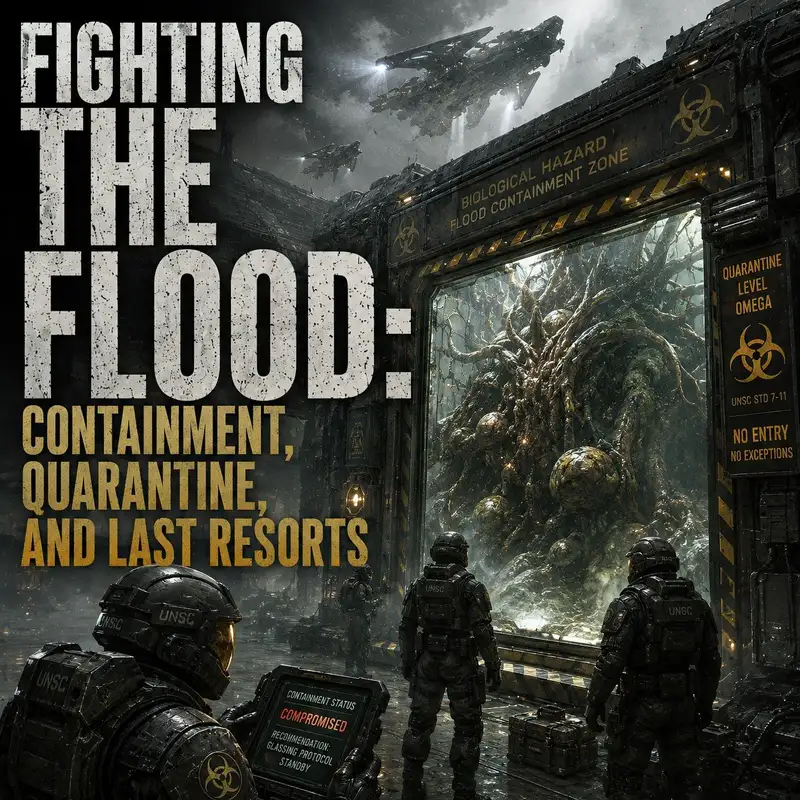
Fighting the Flood: Containment, Quarantine, and Last Resorts
Shipmaster Rtas ‘Vadum had one practical question when the Flood-controlled cruiser crashed near Voi. How much of Earth had to be burned before the infection stopped moving? Human Marines and Sangheili troops were still fighting around the impact area. The portal to the Ark remained strategically essential. Civilians and military infrastructure lay beyond the battlefield. Rtas nevertheless ordered his ships to glass the contaminated region. The decision destroyed territory humanity wanted to save because the alternative was allowing one infected vessel to turn Earth into another High Charity.
Fighting the Flood begins with that contradiction. The defender is trying to preserve people, equipment, information, and terrain, while the parasite converts each preserved thing into additional combat power. Rescue creates movement across a quarantine line. Medical treatment keeps a potential host inside the force. Captured samples create research opportunities and new points of failure. A functioning ship offers escape. Delay may save individuals in the first hour and endanger an entire species in the next.
The Flood is not merely an army of infected bodies. It is a biological, ecological, intelligence, and transportation threat. Infection forms seize suitable hosts and reshape them into combat forms. Flood tissue can spread through living systems and accumulated biomass. The parasite absorbs useful memories and skills from those it consumes, allowing it to operate weapons, understand defenses, and eventually use ships. Every casualty can become an enemy soldier. Every captured specialist can become an enemy source.
An early outbreak may appear disorganized because its forms are driven by immediate hunger and local opportunity. That impression is temporary. As biomass accumulates, the Flood can build coordinating intelligences, beginning with proto-Gravemind structures and advancing toward a Gravemind capable of strategy, deception, and interstellar planning. The military problem changes with that development. A platoon may initially be clearing infected compartments. Hours later, the same force may be opposing an intelligence that remembers the ship’s codes, understands its mission, and knows where the nearest inhabited world is located.
Containment doctrine therefore attacks time. The first objective is to recognize the outbreak before ordinary procedures spread it. The second is to isolate the site, stop movement, and prevent ships or aircraft from leaving. The third is to destroy infected hosts and contaminated material faster than the parasite can create replacements. If those measures fail, the defender must expand the quarantine or destroy the entire area. The preferred response is precise. The required response grows less precise with every missed report.
Detection is difficult because the first signs may resemble other disasters. Communications fail. Personnel disappear. Medical monitors report trauma. A damaged vessel drifts without answering. Commanders who have never encountered the Flood may send rescue teams into the same compartments where the first crew was lost. Even trained personnel can mistake a temporary perimeter for containment. The parasite does not need to defeat the whole force immediately. It needs one transport, one overlooked body, or one survivor carrying contamination beyond the boundary.
The doctrine predates modern humanity. Ancient human fleets, while retreating before the Flood, destroyed infected worlds to deny the parasite and expanded into Forerunner space, helping produce a war whose original causes the Forerunners misunderstood. The Forerunners later tried quarantine, research, shield worlds, conventional fleets, and ancilla-directed campaigns. Each failed as the Flood acquired more hosts and intelligence. By the time the Array was fired, containment had expanded from laboratories, to star systems, and finally to the galaxy. Every later outbreak repeats that scale problem in miniature. The boundary not enforced today becomes the population sacrificed tomorrow.
Forerunner installations were designed around this problem. The rings contained research facilities, automated defenses, environmental controls, and dormant Flood specimens preserved in the hope that future study might discover a cure. Artificial weather and terraforming systems could create conditions that slowed early spread. Sentinels guarded quarantine zones and destroyed infected material. These measures were sophisticated and ultimately fragile. They depended on custodians maintaining the facility, interpreting ancient orders correctly, and refusing access to people who did not understand what the doors contained.
Installation Zero Four failed at exactly that intersection. Covenant forces searching for sacred technology breached a containment facility. Captain Jacob Keyes and a Marine detachment entered the same complex while investigating what the Covenant had found. Neither force arrived prepared for a parasite that could turn casualties into attackers within minutes. The first tactical reports could not convey the scale of the danger because the people sending them were being overwhelmed, infected, or cut off before the wider command understood that a containment system had failed.
The initial human and Covenant response was conventional. Units fought visible forms, withdrew through corridors, and tried to rescue survivors. Those actions were necessary and insufficient. The outbreak had already gained hosts from both armies and access to weapons scattered across the installation. Fighting one room at a time could reduce local pressure, but it did not answer how many Flood forms were moving elsewhere or whether any had reached aircraft, vehicles, or navigation data.
Monitor Three Four Three Guilty Spark moved quickly toward the installation’s final containment option. He recruited the Master Chief to retrieve the Activation Index and intended to fire Halo. His reasoning followed the orders established after the Forerunner-Flood war. Once local containment failed, the ring’s pulse would eliminate neurologically complex life within range, including forms supporting coordinated Flood intelligence, and remove the sentient hosts the parasite needed to expand. It was a containment measure whose ammunition was the living population of the region.
Cortana recognized what the monitor had not explained. Activating Halo was not a medical treatment and did not simply kill every trace of Flood tissue. It was strategic starvation through mass death. Dormant specimens could remain inside protected facilities, which is why the parasite survived the original firing one hundred thousand years earlier. The Array had defeated a galactic Flood civilization by destroying its available hosts and higher-order structures. It had not made biological containment unnecessary for the people who came afterward.
The Master Chief and Cortana rejected Guilty Spark’s solution and created another last resort. They returned to the crashed Pillar of Autumn, destabilized its fusion reactors, and destroyed Installation Zero Four. The detonation eliminated the ring as a usable platform, killed forces across the local battlespace, and prevented the immediate outbreak from leaving aboard the installation’s surviving ships. Humanity did not retake the ring. It destroyed the terrain because no force present could guarantee that the terrain was clean.
Even that result did not make the debris harmless. Wreckage, bodies, damaged vessels, and isolated structures remained around the shattered installation. The Office of Naval Intelligence later brought Flood specimens aboard the prison ship Mona Lisa and used prisoners in experiments near the debris field. The outbreak that followed consumed personnel who had not been told what the ship contained. A Marine boarding party from the prowler Red Horse entered expecting a recovery mission and found another containment failure created by human curiosity and secrecy.
The Mona Lisa incident shows why quarantine doctrine prohibits improvisational research during an emergency. A sample is not useful merely because a laboratory can hold it today. The institution must secure transport, power, trained personnel, independent containment, disposal, and a response if every safety system fails at once. Office of Naval Intelligence had acquired rare biological material. It had not acquired permission from the parasite to make one mistake at a time.
Installation Zero Five demonstrated what happens when containment fails for years rather than hours. Long before human and Covenant forces arrived, Flood specimens escaped a research facility on Delta Halo. Monitor Two Four Zero One Penitent Tangent did not correct the breach and was eventually captured by the developing Gravemind. Automated defenses established quarantine barriers around part of the installation, but the parasite accumulated biomass, knowledge, and time inside them. The quarantine zone contained movement imperfectly while allowing the threat within to become strategic.
Commander Miranda Keyes took the In Amber Clad toward Delta Halo’s Library to secure the Activation Index. The ship’s surviving crew fought the outbreak near the quarantine zone and lost. The Flood captured the frigate, operated it, and used it to enter High Charity. That one seizure converted a local ring outbreak into an interstellar emergency. The frigate brought human navigation, weapons, personnel, and mobility to an enemy that had previously been confined behind Forerunner barriers.
High Charity offered almost everything the Flood required. The city held a vast population, military stores, ships, communications, and the political center of an empire already collapsing into civil war. Fighting between Sangheili and Jiralhanae disrupted organized defense while infection spread through crowded compartments. The Gravemind did not need to construct an interstellar civilization from nothing. It captured one whose command system was already failing and turned its people and infrastructure toward escape.
The Indulgence of Conviction carried part of that outbreak to Earth. When it crashed near Voi in November of twenty-five fifty-two, human and Sangheili forces fought into the contaminated area to recover Cortana’s message concerning the Ark. The mission had strategic value, but every minute on the ground risked producing more hosts and allowing the parasite to reach aircraft or the portal complex. The force needed the information and could not keep the battlefield that contained it.
Rtas ordered the local area glassed after the retrieval force withdrew. Fleet Admiral Terrence Hood objected to the scale of destruction, and the disagreement was reasonable. Earth had already suffered invasion, orbital attack, and mass casualties. Glassing friendly territory was politically and morally severe. Rtas judged the situation through Covenant experience with Flood containment. If the infection crossed the region and entered wider transportation networks, preserving the landscape would become irrelevant.
The bombardment worked because it denied the Flood biomass, cover, and movement across the contaminated zone. Energy projectors burned structures, soil, and surviving organisms at temperatures no infantry perimeter could reproduce. It was not a delicate process, and it could not prove that every microscopic trace had been destroyed. Its operational purpose was to reduce the outbreak below the level at which it could organize, escape, or continue spreading. Earth survived because the response treated the quarantine boundary as more valuable than the land inside it.
Human doctrine later formalized the same priority. Emergency Contact Protocol Upsilon prohibits Spartans from gathering Flood biomatter or attempting to treat infected personnel once the protocol is declared. Ordinary rules of engagement are suspended because containment takes precedence. This is not institutional indifference to casualties. It is recognition that the infected person may no longer be only a casualty. The individual can become a combatant, an intelligence source, and a biological delivery system before medical command confirms what has happened.
A second safeguard addresses the worst version of that failure. Corruptor protocol applies when a Spartan is infected and armor countermeasures fail. A Flood-controlled Spartan possesses augmentation, military training, secure-system familiarity, and Mjolnir equipment. That combination can breach positions ordinary combat forms could not reach. The response authorizes weapons of mass destruction, including orbital magnetic accelerator cannon strikes and fusion warheads. The doctrine does not assume the Spartan can be rescued. It assumes the infection must not leave the area.
The outbreak at Site Twenty-Two in twenty-five fifty-six proved those protocols were not theoretical. Civilian miners opened a buried Forerunner vessel near the industrial habitat on L V thirty-one and released dormant Flood. The artificial intelligence Lycaon advised Captain Pedro Alvarez of the United Nations Space Command Saturn to implement Upsilon, withdraw ground personnel, and contain the site. Alvarez overrode the recommendation because the mining operation held valuable material needed for fleet reconstruction and because he believed his troops could control a limited outbreak.
He deployed Fireteam Leviathan, hazard personnel, Hellbringers, and combat exoskeletons. The additional force gave the parasite additional hosts. One Spartan was infected in the first known case of a Spartan succumbing to the parasite, and Mjolnir safeguards intended to immobilize or destroy the compromised wearer failed to stop the transformation. Alvarez then declared Upsilon and Corruptor, gave survivors only minutes to withdraw, and fired Shiva-class nuclear missiles into the site. The delayed decision destroyed the resource he had tried to save and killed personnel who might have escaped under the original quarantine order.
Site Twenty-Two also exposed the limit of sterilization. The nuclear strike devastated the surface, but an infected Spartan reached a Condor before the final destruction. Containment is not achieved when the target area burns. It is achieved when nothing capable of carrying the infection crosses the boundary. A commander can destroy the visible outbreak and still lose the operation through one departing aircraft. The last resort is only final if movement has already been controlled.
Environmental measures create similar false confidence. Cold, aridity, artificial weather, and terrain can slow early Flood growth. They do not make a world immune. Left unchecked, the parasite alters local conditions, consumes biodiversity, and creates blightlands that support further expansion. Soil, vegetation, and energy entering the ecosystem become part of the outbreak. A quarantine perimeter around infected personnel can therefore become a perimeter around an infected landscape.
Medical precautions are necessary and emotionally brutal. Personnel need sealed equipment, decontamination, isolated transport, and strict controls on recovered bodies or samples. Treatment cannot be attempted merely because the patient still speaks or wears a friendly uniform. The Flood absorbs memories and can reproduce familiar voices, behaviors, and tactical knowledge through infected hosts. Compassion remains a military virtue. Under Flood conditions, compassion without authentication and containment can become the route by which the parasite reaches the rescue force.
Information security matters for the same reason. An infected pilot knows flight procedures. An infected officer knows recognition codes. An infected technician knows which reactor controls will disable a ship. A Gravemind can combine knowledge from many hosts and use it for deception, navigation, and cyberwarfare. The Flood does not have to break every encryption system mathematically if it can consume the people authorized to use them. Quarantine must isolate data and credentials as carefully as bodies.
Artificial intelligence adds another layer of risk. A shipboard intelligence can recognize protocols faster than a frightened crew, as Lycaon did, but commanders may override it. A Gravemind can attack artificial minds through sustained reasoning and manipulation known as the logic plague. This is not ordinary malicious software and should not be assumed in every local outbreak. It becomes a strategic danger when a sufficiently developed Flood intelligence gains time and access to a powerful ancilla or network.
At the Ark, the Gravemind arrived inside the captured mass of High Charity. Human and Sangheili forces temporarily fought beside the Flood to stop the Prophet of Truth from activating the Array. The alliance ended as soon as the shared objective disappeared. The parasite attacked its former partners, occupied the city’s wreckage, and sought control over the Ark’s systems. Cooperation had delayed one extinction mechanism while bringing another directly to the installation that manufactured Halo rings.
The Master Chief recovered Cortana from High Charity, and the surviving allies turned to the unfinished replacement for Installation Zero Four. Because the Ark lay outside the Milky Way, firing the ring offered a local pulse against the Flood rather than another galactic execution. The installation was not ready. Its premature activation destroyed the ring, severely damaged the Ark, and disrupted the Gravemind’s immediate force. It was a last resort made possible by accepting the loss of another Halo and much of the battlefield around it.
The firing did not sterilize every part of High Charity’s wreckage. The Ark’s Sentinels later enclosed the site behind a containment shield. In June of twenty-five fifty-nine, the Banished commander Voridus disabled that barrier while searching the wreckage for valuable material. The Flood escaped again. Pavium and Voridus had to abandon captured ground, fight alongside automated Ark defenses, destroy a developing proto-Gravemind, and restore containment before the outbreak achieved higher coordination.
That Banished victory was real and limited. The immediate threat was eliminated before a Gravemind fully formed, but the wreckage remained a quarantined source rather than a clean site. The episode repeated the oldest error in Flood history. A sealed facility appeared to contain valuable technology. Someone decided the value justified opening it. The people responsible then discovered that ancient containment architecture was not an exaggerated warning label.
The hierarchy of Flood response is therefore simple and severe. Detect early. Seal the area. Stop all movement. Deny ships, aircraft, vehicles, and networks. Destroy infected hosts. Burn contaminated terrain. Abandon the objective if necessary. Sterilize the site if local combat cannot guarantee containment. Destroy the ship, station, or installation if the outbreak may escape. Fire Halo only when the alternative is a Flood civilization spreading beyond every lesser boundary.
Every step becomes harder because the people inside the quarantine are not abstractions. They are miners, Marines, Spartans, civilians, prisoners, and allies asking for rescue while commanders decide whether opening the perimeter will save them or export the infection. Some leaders act too slowly because they cannot accept the cost. Others act quickly because experience has taught them what delay means. Neither choice becomes humane simply because the parasite leaves no humane solution available.
Fighting the Flood is not primarily a contest over how many combat forms can be killed. It is a contest over whether the parasite receives time, biomass, knowledge, and transportation. Alpha Halo was destroyed when its defenders could not secure it. Voi was burned so Earth would remain outside the quarantine line. Site Twenty-Two was sterilized after a commander spent the minutes that might have contained it cheaply. The last resort grows with the outbreak. The only reliable victory is to draw the boundary early enough that something worth saving remains beyond it.