First Contact at Harvest
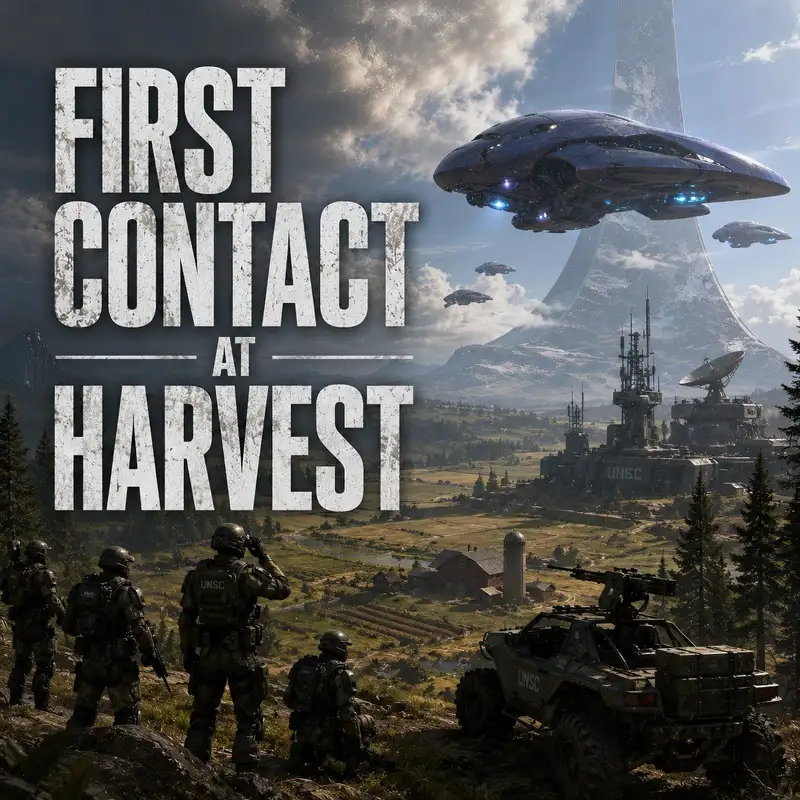
At the Harvest Botanical Gardens on February eleventh, twenty-five twenty-five, humanity placed fruit on a table for aliens it could not understand. The human delegation arrived with civilian officials, intelligence personnel, Marines, and a newly trained militia. The Covenant party brought Jiralhanae warriors, Unggoy attendants, dropships, and a religious conviction that the people before them were connected to sacred Forerunner relics. No shared language or trusted translator stood between the armed groups. Within moments, gunfire ended the first formal meeting between humanity and the Covenant.
That exchange is often described as the beginning of the Human-Covenant War. It was the visible beginning, not the true cause. First contact at Harvest unfolded through a chance discovery by alien privateers, the killing of a civilian captain, a United Nations Space Command ambush intended for Insurrectionists, a failed diplomatic meeting, and an order of extermination from Covenant leaders on High Charity. The central question is why neither military success nor peaceful communication could prevent one civilization from deciding that the other had to disappear.
Harvest was an unlikely place for interstellar war to begin. Founded in twenty-four sixty-eight in the Epsilon Indi system, it was an Outer Colony built around agriculture rather than heavy industry or fleet operations. Its farms and automated harvesters supplied food to several colonies. Utgard, the capital, connected to the orbital station Tiara through seven space elevators designed for bulk cargo. Harvest held economic value but little conventional military power. Its defenses consisted of police, a new militia, and a handful of experienced service members preparing civilians for internal emergencies.
Those preparations were aimed at humans. Staff Sergeants Avery Johnson and Nolan Byrne, Captain Ponder, and hospital corpsman Healy had been sent to train the militia because the Insurrection remained the security problem the government understood. Freighters had disappeared in the region, and the Office of Naval Intelligence suspected separatists. That assumption was reasonable and dangerous. The personnel preparing to meet the Covenant were not diplomats or xenologists. They were counterinsurgency veterans expecting smugglers, saboteurs, or rebels.
Late in twenty-five twenty-four, the unmanned freighter Horn of Plenty suffered a slipspace malfunction and emerged near a small Covenant missionary vessel named Minor Transgression. Its Kig-Yar crew disabled and boarded the freighter, then examined its navigation data. The ship’s Luminary, a device used to locate Forerunner artifacts, detected an extraordinary number of supposed relics associated with Harvest. The Kig-Yar withheld part of the discovery. They operated under Covenant religious authority but were also privateers motivated by profit, prestige, and the chance to take valuables before a ministry claimed them.
Minor Transgression began raiding more human ships. Aboard the freighter This End Up, Captain Henry Gibson became the first human known to confront Covenant personnel directly. He died during the encounter. The aliens gained information about Harvest, while humanity received no coherent warning about its attacker. This was not diplomacy between governments. It was contact between a civilian mariner and raiders whose society treated relic hunting, missionary work, and private acquisition as overlapping activities. The first person-to-person encounter ended before either side understood that it had met another interstellar civilization.
The Office of Naval Intelligence set a trap aboard the freighter Bulk Discount on January seventeenth. Lieutenant Commander Jilan al-Cygni directed the operation. Johnson and Byrne waited in vacuum suits with prototype battle rifles, expecting Insurrectionist boarders. Four Kig-Yar entered instead. Once the Marines recognized that the targets were alien, al-Cygni ordered them to continue, capture one if possible, and prevent escape. The fight wounded both Marines, killed the boarders, and carried Johnson into Minor Transgression. Its shipmistress activated a self-destruct sequence rather than surrender. Johnson and Byrne escaped. The missionary ship did not.
The Unggoy deacon Dadab and the Huragok engineer Lighter Than Some escaped and carried word of Harvest to other Covenant forces. The United Nations Space Command had won its first engagement with the Covenant but gained little understanding. No prisoner survived. The alien ship was destroyed. Human intelligence knew it had encountered advanced nonhumans, but not how many species belonged to their polity, how far it extended, or what its leaders wanted. Counterinsurgency doctrine solved the boarding action and left the strategic problem untouched.
The Covenant also misunderstood what it had found. Luminaries were trusted religious instruments used to identify Forerunner technology. On Harvest, they appeared to show a world covered in sacred objects. The crew of Minor Transgression assumed the planet concealed an immense store of relics. The instruments were actually identifying human beings. In Forerunner systems, humanity carried the status of Reclaimer. Covenant theology had built a civilization around recovering Forerunner works, but its religious language had confused Reclamation with the identity of those designated to reclaim that inheritance.
The report reached the Minister of Fortitude and the Vice Minister of Tranquility on High Charity. They were ambitious San’Shyuum officials maneuvering to replace the existing Hierarchs. With the Philologist, they brought the Harvest data before the ancient intelligence the Covenant regarded as an Oracle. The intelligence was a fragment of Mendicant Bias, and it corrected the translation. The marks on Harvest did not indicate abandoned relics. They indicated Reclaimers. The Oracle then attempted to move the Forerunner dreadnought at High Charity’s center so it could take the humans toward the Ark.
For the three San’Shyuum, this was not an archaeological correction. It threatened Covenant political authority. If living humans possessed a relationship to the Forerunners that Covenant leaders had misunderstood, the ministries controlling relics could lose power and the Great Journey could be questioned. The San’Shyuum might no longer stand between the Covenant and its gods. Fortitude, Tranquility, and the Philologist concealed the revelation, became the Prophets of Truth, Regret, and Mercy, and classified humanity’s existence as evidence against the empire’s legitimacy.
Their solution was extermination. The Covenant did not declare war because Harvest possessed a fleet, threatened High Charity, or rejected a treaty. Its new leaders decided that humans had to die before the rest of the Covenant learned what the Oracle had revealed. Religion made the discovery dangerous. Political ambition determined the response. Military power made genocide appear practical. The firefight in the botanical gardens turned local tension into open combat, but even a perfectly disciplined meeting could not resolve an order based on hiding the identity of the people attending it.
Before that order reached the surface, the cruiser Rapid Conversion entered the Epsilon Indi system on February third. Its shipmaster, the Jiralhanae chieftain Maccabeus, was a capable warrior and sincere believer. His orders ultimately required the colony’s destruction, but his Luminary indicated that Harvest contained thousands of sacred Oracles. Maccabeus delayed bombardment because he wanted to recover them. That choice gave the colonists time and placed him in conflict with his nephew Tartarus, who saw hesitation as failed command and an obstacle to his own rise.
Tiara detected Rapid Conversion at long range and identified materials and energy signatures beyond human science. The station could observe the vessel but not determine intent. Human authorities transmitted simple images showing people offering fruit to Kig-Yar figures, an attempt to propose trade and peace. Maccabeus accepted a meeting. Humanity had no protocol capable of bridging alien language, religion, rank, and physiology in a few days. The message had to perform the work of an embassy with the expressive range of a carefully arranged picture.
The botanical-garden meeting brought together Governor Nils Thune, Attorney General Rol Pedersen, Captain Ponder, al-Cygni, Johnson, Byrne, and militia security. Maccabeus arrived with Jiralhanae and Unggoy personnel, while Tartarus led a separate search for supposed Oracles nearby. That activity undermined the meeting. The humans believed they were hosting a controlled parley. The Covenant treated the site as both a diplomatic venue and a religious search area. Each side brought weapons because neither trusted the other, and neither could reliably distinguish ceremony, warning, fear, and aggression.
An overeager Unggoy attacked and killed the militiaman Osmo. The gunfire prompted the Jiralhanae Vorenus to kill Pedersen. Johnson and Byrne wounded Licinus, another Jiralhanae, and the Covenant delegation withdrew. The exchange was brief, confused, and decisive at the tactical level. Command and control had failed on both sides. Maccabeus did not control every subordinate around the site. The human delegation could not explain its security posture. Weapons supplied clarity only in the narrow sense that everyone immediately understood they were now in danger.
The failed parley did not make war inevitable. War was being chosen elsewhere. Maccabeus withdrew to Rapid Conversion and awaited guidance from High Charity. The order that arrived did not call for another meeting, a demand for access, or a limited strike. It called for the colonists to be destroyed. The Human-Covenant War was not caused by one nervous soldier or one undisciplined Unggoy. The garden incident was a trigger inside a political decision made by leaders who understood that peaceful contact threatened their authority more than armed resistance did.
For roughly a week, Rapid Conversion remained in high orbit. Human authorities directed civilians toward Utgard, where the space elevators offered the only practical route to mass evacuation. Many residents of Gladsheim stayed behind. Some believed the remote town would be ignored. Others could not imagine abandoning farms, families, and property because of one incomprehensible encounter. Civil defense looks clearer from a command center than from a kitchen table. A warning persuades only when people believe the threat is real, the destination safer, and transportation still available.
On February twenty-second, Rapid Conversion moved above Gladsheim and used its ventral plasma weapon against surrounding settlements while Covenant forces searched for Oracles that were never objects. Johnson, Byrne, and militia squads moved civilians toward the maglev terminal and Utgard. A convoy fleeing through vineyards was attacked by a Spirit dropship. Johnson and Byrne found abandoned vehicles and bodies, rescued one survivor, and used a Warthog to strike Maccabeus when he exposed himself. The Covenant possessed orbital firepower. The defenders possessed local roads, improvised mobility, and almost no margin for error.
Harvest’s agricultural infrastructure became part of the defense. Mack, the artificial intelligence responsible for planetary farming operations, controlled thousands of JOTUN machines. He redirected cropdusters against a pursuing Spirit and destroyed it, turning equipment designed to cultivate fields into an improvised air-defense weapon. The action did not change the balance in orbit. It did buy time for survivors to reach Utgard. This was the first-contact version of a lesson humanity would relearn throughout the war: advanced enemy technology could sometimes be defeated locally by ingenuity, but local success did not remove the enemy ship overhead.
Gladsheim was destroyed, and panic spread through Utgard. Al-Cygni assumed military control from Governor Thune and finalized the evacuation on February twenty-third. No human fleet stood ready in the system. Harvest’s best escape route was the same industrial network that normally carried food into orbit. Cargo containers would become passenger compartments. Freighters and propulsion pods would become evacuation vessels. The Tiara and its seven elevator strands were now more strategically important than any government building. The colony’s survival depended on a logistics system designed for predictable schedules operating under bombardment, sabotage, overload, and combat.
The evacuation system depended on artificial intelligences. Sif controlled shipping, Tiara, and elevator traffic. Mack controlled agriculture and machinery. The planetary security intelligence Loki emerged when military danger required different priorities. Loki tried to deny the Covenant Sif’s data, including information that could expose other human worlds. Lighter Than Some, horrified by the violence, partially repaired Sif and helped the human intelligences understand the Covenant’s interest in Oracles. The first human-Covenant cooperation came not from senior diplomats, but from an alien engineer and damaged software trying to stop the killing.
Captain Ponder used that intelligence to construct a deception. Already mortally wounded, he presented the Covenant with a false Oracle and lured Rapid Conversion into the firing arc of Harvest’s mass driver. The device had been built to launch nuclear waste toward the system’s star, not fight cruisers. Loki fired twice. One projectile struck with limited effect. The second tore through critical connections between the ship’s reactor and antigravity systems, forcing Rapid Conversion down into Utgard. Humanity’s first effective anti-ship weapon in the war was industrial equipment aimed by an artificial intelligence at a target distracted by its own religious assumptions.
Tartarus killed Ponder after the deception became clear, then challenged his injured uncle for leadership. He killed Maccabeus with the Fist of Rukt and assumed command. The struggle revealed that the Covenant force contained its own politics. Maccabeus valued relic recovery, piety, and caution. Tartarus valued obedience, dominance, and advancement. The change of command removed the figure most willing to delay destruction. First contact was shaping future Covenant leadership while the wider empire still knew almost nothing about the species it had ordered exterminated.
On the surface, Byrne and militia volunteers defended the reactor complex, mass driver, and Loki’s data center against Jiralhanae riding newly created Choppers. Those vehicles had emerged from designs produced by Lighter Than Some, whose useful machinery was weaponized by the Jiralhanae. Mack drove agricultural machines into the fight, distracting and crushing attackers while the militia finished the engagement. The defenders held the complex but suffered devastating losses. Harvest’s seventy-two recruits had trained for internal security. They were now fighting armored alien shock troops to preserve the systems evacuating their neighbors.
The evacuation was an exercise in brutal throughput. Hundreds of cargo containers loaded with civilians climbed the seven strands toward Tiara. Maintenance containers known as grease buckets went first. Some carried Johnson, al-Cygni, Healy, and militia assault teams. Others were packed with claymore mines to strike the Covenant forces occupying the orbital station. At the top, the cargo had to clear Tiara, connect with propulsion pods, and enter slipspace. Every delay threatened the balance of the elevator system. Every firefight risked disabling the station that held the entire evacuation together.
The decoy containers detonated among the Unggoy defenders on Tiara, opening the way for the militia. Fighting spread through the station against Unggoy, Yanme’e, and Jiralhanae forces. Lighter Than Some was killed by Yanme’e resentful that the Huragok had displaced their technical role and left them exposed to combat. Dadab, already shaken by the loss of friends and by Tartarus’s brutality, turned his plasma pistol on the new chieftain. The shot collapsed Tartarus’s shields and saved Johnson from immediate death. Tartarus killed Dadab and withdrew. The Covenant’s first battle with humanity contained rebellion inside the Covenant itself.
The evacuation’s greatest loss came from physics rather than enemy fire. One elevator strand failed under the strain, carrying multiple container pairs and roughly twenty thousand people to their deaths. The collapse unbalanced the remaining system while its control intelligences were damaged and divided over security priorities. Sif restored enough balance for the surviving loads to continue. Later sources do not agree perfectly on Harvest’s total population, but the operational truth is clear. Industrial cargo handling saved hundreds of thousands of lives and failed catastrophically for thousands more.
The last militia personnel withdrew from Tiara and joined the escaping freighters. Loki used the mass driver to destroy the station, denying its systems and data to the Covenant and bringing the elevator strands down around the planet. Rapid Conversion was damaged, not destroyed. Its crew repaired the vessel and continued burning Harvest. Fragments of Mack remained distributed among agricultural machines, trying to warn approaching human ships and preserve what little he could of Sif’s ruined infrastructure. The colony’s fields became a graveyard while human command elsewhere still lacked a complete report.
The Colonial Military Administration sent the scout ship Argo to investigate. It arrived on April twentieth and transmitted only once before Rapid Conversion destroyed it. A larger force followed in October: the destroyer Heracles and the frigates Arabia and Vostok. They encountered a Covenant warship holding the system. The engagement lasted fourteen seconds. Covenant defenses defeated incoming missiles, plasma weapons destroyed both frigates, and the damaged Heracles escaped. It took weeks to return to Reach. Only then did human leaders receive undeniable evidence that Harvest was not an isolated disaster or Insurrectionist deception.
On November first, the United Nations Space Command went to full alert. Spartan training accelerated, fleets assembled, and the government prepared to retake Harvest. The first-contact period had already revealed the strategic imbalance. A lightly defended agricultural colony had been destroyed by one damaged Covenant cruiser and supporting troops. A three-ship human battle group had been broken in seconds. Humanity could evacuate, improvise, and occasionally wound the enemy. It did not yet possess a reliable method for stopping the enemy from returning.
First contact at Harvest became war through three connected failures. Human intelligence interpreted unexplained raids through the familiar lens of the Insurrection and met the first alien boarders with an ambush. Local diplomacy failed because armed parties without a common language or shared procedure could not control every subordinate. Above both events, Covenant leaders chose genocide because humanity’s recognized status as Reclaimer threatened their religious and political monopoly. The first two failures made violence easier. The third made peace unacceptable.
Harvest established the pattern of the war. Covenant technology dominated the strategic level, especially in space. Human defenders survived through deception, local knowledge, artificial intelligence, industrial improvisation, and sacrifice. Covenant forces were never uniform. Kig-Yar privateers, an Unggoy deacon, a Huragok engineer, rival Jiralhanae leaders, and ambitious San’Shyuum ministers wanted different things from the encounter. Humanity was equally divided among colonial officials, intelligence officers, militia volunteers, civilians, and soldiers trained for another enemy. The war began between civilizations, but individuals determined who escaped its first battlefield.
The defining image is fruit placed at the botanical gardens beside weapons neither delegation understood. Humanity offered trade because it believed contact might be negotiated. Maccabeus accepted because he believed sacred objects could be recovered. Far away, three officials decided that the people at the table were themselves dangerous evidence. Harvest was not destroyed because communication proved impossible. It was destroyed because communication, if allowed to reveal the truth, threatened the Covenant’s ruling order. The war began when an empire chose to protect its faith and political authority by killing everyone who could expose the difference.