Ghosts, Wraiths, Choppers, and Banshees
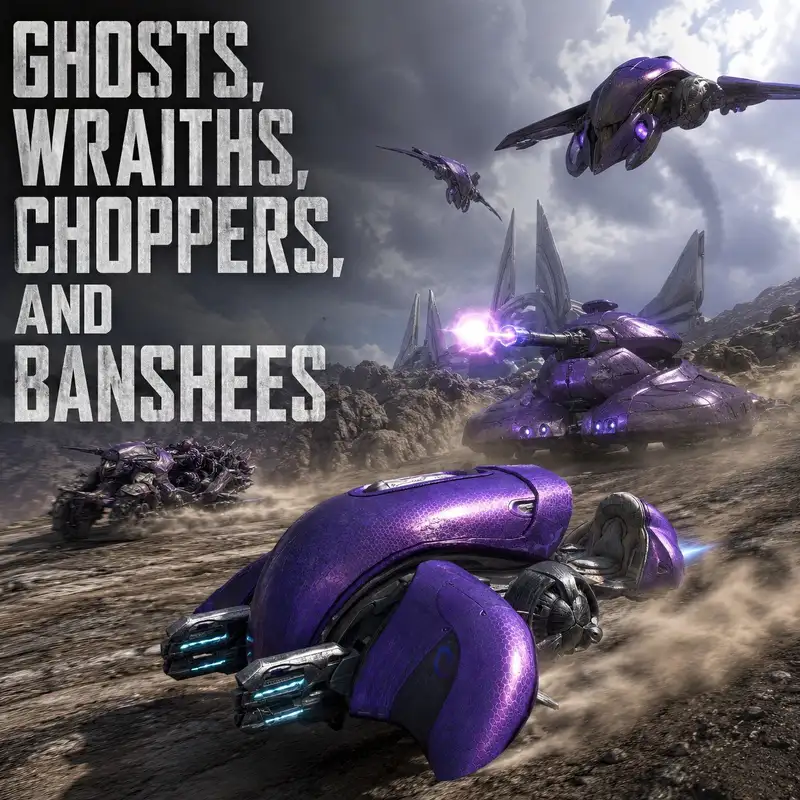
When Banished dreadnoughts shattered the United Nations Space Command formation above Zeta Halo, they carried more than boarding troops and drop bases. Their vehicle complements included Ghost scouts, Chopper raiders, Wraith mortar tanks, and Banshee flyers. Once the Infinity’s survivors were scattered across the ring, those machines helped turn a naval victory into a ground occupation. They patrolled roads, shelled refuges, hunted vehicles, and contested the air between isolated human positions.
The four vehicles formed a mobile combined-arms system. Ghosts found routes and struck exposed flanks. Wraiths placed heavy plasma fire onto positions infantry could not easily break. Choppers closed violently with personnel and light vehicles. Banshees carried the fight over terrain that ground forces could not cross quickly. None was perfect. Together, they gave Covenant and later Banished commanders several ways to control movement without waiting for a capital ship to solve every problem from orbit.
Their familiar names can hide important differences. Ghost, Wraith, Chopper, and Banshee were human labels applied to vehicle families containing several design patterns, manufacturers, and wartime modifications. A vehicle encountered on Installation Zero Four was not necessarily identical to one fielded on Reach, Sanghelios, the Ark, or Zeta Halo. The tactical role remained recognizable while armor, weapons, propulsion, and political ownership changed around it.
The Ghost was the lightest and most widely adaptable member of the system. The Karo’etba-pattern scout bike, classified by humanity as the Type Thirty-Two Rapid Attack Vehicle, served as a standard Covenant reconnaissance and rapid-assault platform. One pilot sat low in an open control position while a boosted gravity drive carried the vehicle just above the surface. It needed no road, no tire pressure, and very little patience for ordinary obstacles.
Control depended on more than two steering grips. The pilot shifted weight through a jointed seat while holographic displays provided targeting and a wide view ahead. The open cockpit reduced mass and gave the rider an unobstructed relationship with the vehicle. It also left the pilot exposed. Human intelligence analysts suspected Sangheili designers considered that exposure a display of fearlessness. Whatever the intention, human marksmen treated it as a useful engineering concession.
Twin plasma cannons gave the Ghost enough firepower to attack infantry, light vehicles, and exposed equipment. A gravity boost allowed rapid repositioning or a sudden charge through a weak point. The vehicle could cross open ground, skim through shallow water, and follow terrain that slowed wheeled patrols. It was not a miniature tank. Its protection came from speed, a low profile, and the pilot’s ability to make the firing solution disappear before the enemy completed it.
Reconnaissance was the Ghost’s first military value. A patrol could search a broad area, inspect a route, watch a landing zone, or pursue a withdrawing unit without committing a dropship. Once contact was made, the same vehicle could harass the enemy, mark targets, or hold attention while heavier forces maneuvered. A scout that can also burn through infantry armor creates an unusually persuasive form of reporting.
Ghosts worked best in groups and with supporting troops. Several riders could spread across a frontage, attack from different directions, and exploit gaps that a Wraith could not reach quickly. Infantry could occupy cover while Ghosts forced human units to turn outward. Banshees could drive vehicles from concealment and into the riders’ path. The Ghost’s speed made it valuable because the larger formation knew what to do with the information and disruption it created.
The same speed encouraged misuse. A boosting rider had less time to react to mines, obstacles, and anti-vehicle fire. The pilot remained vulnerable from the sides and rear. Concentrated rifle fire, heavy machine guns, rockets, grenades, and well-placed vehicle weapons could destroy the light chassis or kill the operator. Spartans sometimes boarded or commandeered Ghosts during combat, but that was an exceptional close-assault solution rather than an ordinary anti-vehicle doctrine.
Anti-gravity did not eliminate logistics. Ghosts required charged power systems, functioning gravity-drive components, plasma weapons, control electronics, and technicians who understood them. Dropships could place them near a landing force, but every delivered scout still occupied transport capacity. A damaged Ghost might look more intact than a burning Warthog while containing a failed field generator that no frontline infantry unit could repair.
The vehicle survived the Covenant because the requirement survived. Sangheili successor factions produced later patterns with improved protection and performance. The Swords of Sanghelios, Covenant remnants, and independent forces all retained Ghosts. The Banished Riuctda Workshop version added stronger forward armor and more aggressive plasma systems. On Zeta Halo, Ghosts again served as high-speed scouts and raiders, now supporting an occupation that rejected Covenant religion while preserving much of its useful equipment.
The Wraith occupied the opposite end of the ground formation. Human troops often called it the Covenant tank, but mortar tank or armored assault gun better describes its role. The Zurdo-pattern Wraith combined heavy protection, anti-gravity mobility, and a plasma mortar able to attack infantry, armor, and structures. It could accompany an assault, defend a base, or shell a target from behind terrain. A Scorpion sought a direct firing line. A Wraith often preferred an arc.
The pilot sat inside an armored cockpit and relied on holographic displays for a full view around the vehicle. Later wartime models commonly carried a second operator on a ring-mounted plasma cannon for close defense. A boosted gravity drive kept the broad chassis above the ground and allowed limited bursts of speed. The arrangement crossed rough terrain differently from human tracks, though mass and momentum still made tight maneuver difficult.
Its heavy plasma mortar created a magnetically contained projectile and sent it along a ballistic path toward the target. The glowing bolt traveled more slowly than a conventional tank round, giving a fast vehicle some opportunity to evade. That apparent weakness made the weapon useful for indirect fire. A Wraith could place destructive thermal energy behind cover, into defensive works, or across an avenue the enemy needed to cross.
The mortar’s fixed relationship to the chassis forced the driver to orient the vehicle toward the target. That made firing position and route selection important. The Wraith could not sit behind every hill and strike in every direction without moving. Once located, it was vulnerable to flanking attacks, aircraft, rockets, tanks, and assault troops able to reach its rear. The exhaust and propulsion area behind the cockpit remained a particularly useful place to apply explosives.
A secondary plasma weapon protected against infantry approaching the vehicle, but the gunner was more exposed than the driver. Human units learned to suppress the turret, distract the crew, and attack from several directions. Warthogs could exploit speed against the mortar’s flight time. Scorpions could engage from range. Spartans could close and board under circumstances that would be fatal to ordinary soldiers. None of these methods made the Wraith harmless. They prevented it from using its preferred engagement without interruption.
Wraith doctrine joined artillery and armor in one platform. The vehicle could prepare a position before infantry advanced, break a fortified line, deny a landing zone, or support other vehicles from behind the immediate fight. It was especially valuable to an expeditionary force that had landed without a separate human-style artillery train. Covenant dropships could deliver armored plasma fire close to the objective, then move the tank as the frontline changed.
In cities and colonial settlements, that indirect-fire capability carried consequences beyond the selected target. A plasma impact could destroy shelter, ignite nearby material, and cut the route used by civilians or medical personnel. Covenant commanders were not always trying to preserve the infrastructure below them, and some operations treated destruction as part of the religious war. A Wraith crew could therefore achieve its fire mission while making later occupation, recovery, or intelligence collection more difficult.
Specialized variants expanded the family. Anti-aircraft Wraiths replaced the heavy mortar with weapons intended to threaten aircraft. Postwar designs improved armor, mobility, and weapon systems. Banished workshops removed restrictions inherited from Covenant religious administration and treated the old chassis as a starting point rather than a sacred pattern. The Bolroci Workshop Wraith used overlapping armor and a rapid-fire secondary weapon while preserving the mortar that made the vehicle useful.
The Wraith’s power supply, cooling systems, armor, and plasma weapons still required industrial support. A tank that floated did not become weightless inside a transport manifest. Its crew needed training, maintenance personnel, replacement components, and a supply system able to keep its energy weapons operational. The vehicle was more flexible than a fixed artillery piece. It was considerably less flexible than the procurement description tended to suggest.
The Chopper entered Covenant warfare through one of the setting’s more revealing misunderstandings. During first contact at Harvest, the Huragok known as Lighter Than Some assembled machines from damaged Spirit components as a peace offering. The design echoed human agricultural equipment on the colony. Maccabeus’s Jiralhanae clan saw a war vehicle instead. The machines became cavalry, and a tool intended to ease contact between species helped make that contact more violent.
Later Choppers turned that improvised beginning into a formal assault-bike family. A massive paired front wheel and bladed ramming structure protected the vehicle from ahead. The driver rode behind it in a seat supported by gravity technology. Heavy spike cannons fired explosive projectiles along the direction of travel. Short boosts gave the Chopper enough speed to smash barricades, infantry, and light vehicles before the target could move clear.
The vehicle’s doctrine was direct. Spike fire disoriented or damaged the target. The rider then closed and used the entire machine as a weapon. A Chopper could scout, raid a convoy, pursue a retreat, or disrupt a vehicle formation whose drivers were already watching for Ghosts and plasma fire. It was not subtle, though subtlety is not always required when the front of the vehicle has been designed to thresh the opposition.
Its protection was directional. The wheel and ram shielded the rider from the front, while the sides and rear remained exposed. The Chopper turned less gracefully than a Ghost and became vulnerable when it lost momentum or entered confined terrain without room to align a charge. Mines, crossfires, heavy weapons, and disciplined drivers could defeat it. A ramming attack was decisive only if the rider reached the target before the target’s gunner reached the correct conclusion.
The Chopper also carried political meaning. It remained closely associated with Jiralhanae formations rather than becoming a universal Covenant vehicle. Its increasing presence during the final year of the Human-Covenant War reflected the elevation of Jiralhanae troops and the coming purge of the Sangheili. Where the Ghost represented an established imperial standard, the Chopper announced that a different military culture was moving toward the front of the empire.
The Banished adopted that culture openly. The Bolroci Workshop Chopper drew on knowledge from several Jiralhanae clans and became a common Banished raiding vehicle. Workshop production replaced Covenant ministry approval, and riders continued painting or personalizing their machines. The Catulus variant became a commander’s war chariot, later used by the Spartan killer Hyperius on Zeta Halo. Status and battlefield function remained attached to the same wheel.
Banished logistics made the Chopper less improvised than it appeared. Spare wheels and complete vehicles were stored at facilities such as the Forge of Teash. Workshops produced spike ammunition, replacement frames, gravity components, and specialized variants. The machine looked like a raider’s personal weapon because its rider sat exposed behind a giant blade. Behind the rider stood an industrial system that had remembered to stock replacement wheels.
The Banshee extended the same mobility into the air. The name covered several atmospheric and exoatmospheric attack-flyer patterns rather than one universal model. Common ground-support versions carried a single pilot, boosted-gravity propulsion, twin plasma cannons, and a fuel-rod weapon. They could hover, accelerate rapidly, roll through tight maneuvers, and attack from angles unavailable to Ghosts, Wraiths, or Choppers.
A Banshee could scout ahead of a landing force, escort dropships, suppress infantry, attack vehicles, and pursue aircraft near the surface. Its plasma cannons handled exposed targets and light armor. The heavier fuel-rod weapon gave the pilot a more destructive option against vehicles and fortifications. That mix made the Banshee a multirole ground-support aircraft, not merely a flying plasma rifle.
Standard atmospheric Banshees should not be confused with dedicated space fighters. Vacuum-capable variants existed, and massed Banshees could screen fleets or overwhelm heavier opponents under favorable conditions. Seraphs remained better suited to high-end aerospace combat. The Banshee’s greatest strength was that it could support the ground battle, operate from Covenant ships, and appear in numbers without consuming the resources of a larger fighter.
Light construction and exposed cockpit features made many Banshee patterns vulnerable to concentrated fire. Machine guns, rockets, tanks, air-defense vehicles, and friendly fighters could destroy them. The pilot’s agility reduced that danger only while terrain and awareness supported maneuver. Hovering over a defended position offered an excellent view of the battlefield and allowed everyone on the battlefield an excellent view of the Banshee.
Covenant pilots used speed, altitude changes, terrain masking, and repeated attack passes. Several aircraft could divide defensive fire while one struck the target. Banshees could force Warthogs from open routes, pressure Pelicans approaching a landing zone, and punish infantry that had already dispersed to avoid Wraith fire. Their contribution was strongest when the air attack was coordinated with what the ground vehicles were doing below.
Close-air support also required target identification. A fast pilot looking through smoke and plasma fire could mistake a damaged friendly vehicle for an enemy one or attack a position moments before allied infantry reached it. Covenant battle networks and unit discipline reduced that risk when they functioned. Political rivalry, mixed-species command, and the confusion of the Great Schism made it worse. An agile aircraft can reach the wrong target with admirable efficiency.
The aircraft still depended on ships, hangars, docking points, maintenance teams, and energy support. One pilot controlled the vehicle, but one pilot did not arm, repair, transport, and recharge it alone. A fleet that lost its carriers and workshops could keep surviving Banshees flying only while stored parts and technical knowledge lasted. The Great Schism divided the aircraft more quickly than it divided the industrial skills required to sustain them.
Banished Banshees illustrate that inheritance. Kaelum Workshop modified an older Sangheili-derived airframe with additional armor and a form intended to preserve speed and maneuverability. On Zeta Halo, these aircraft fought human survivors and the ring’s Sentinel defenses. The Banished had not invented the Banshee. They had removed it from the Covenant’s religious ownership, rebuilt it for occupation, and placed it inside a new military economy.
Taken together, the four vehicles controlled different dimensions of movement. A Ghost located a convoy or forced it to turn. A Wraith placed plasma on the route the convoy needed. A Chopper attacked the vehicles trying to break through. A Banshee watched from above, struck exposed targets, and threatened the aircraft sent to help. This was not a rigid formation used identically by every commander. It was a set of capabilities that could be combined according to terrain and mission.
Species and politics shaped how the system was assembled. Ghosts, Wraiths, and Banshees came from established Covenant and Sangheili technical traditions and could be issued across different units. Choppers remained distinctly Jiralhanae. During the Great Schism, those vehicles helped make factional identity visible on the battlefield. After the empire collapsed, the same machines served the Swords of Sanghelios, religious remnants, pirates, mercenaries, and the Banished.
The vehicles also reveal the difference between inheriting technology and inheriting an empire. Successor factions could seize tanks, flyers, and design patterns. They still needed mines, forges, technicians, power systems, transport ships, and crews. The Banished succeeded better than many remnants because it connected salvage and captured industry to workshops willing to modify old designs. It treated standardization as useful and sacred approval as optional.
Human forces captured all four vehicle types at different times. A trained soldier or Spartan could often recognize the controls and turn the machine against its former owner. That created tactical surprise and solved an immediate mobility problem. It did not give humanity a sustainable Ghost squadron or Wraith battalion. Operating a captured vehicle for one engagement is considerably easier than manufacturing its gravity drive and supplying it through a campaign.
Countering the vehicles required the same combined-arms discipline they were designed to defeat. Infantry marked routes and protected anti-armor teams. Tanks engaged Wraiths. Warthogs outmaneuvered mortar fire. Air-defense weapons forced Banshees away from landing zones. Mines and crossfires punished Chopper charges. No single answer worked against every vehicle, because the system was built to make the defender divide attention.
Their strategic limits remained clear. Ghosts could patrol a region without governing its population. Wraiths could destroy a refuge without locating every survivor. Choppers could terrorize a road without sustaining an occupation by themselves. Banshees could dominate a valley while hostile fighters or ships contested the wider sky. These vehicles made local control possible. They did not make political control automatic.
On Zeta Halo, the Banished combined them with dreadnoughts, Phantoms, drop bases, workshops, prisons, salvage sites, and artillery. That larger structure turned four vehicle families into an occupation system. The vehicles were effective because the Banished could deploy them, repair them, and replace their ammunition while human survivors could rarely do the same for their own losses.
Ghosts, Wraiths, Choppers, and Banshees endured because each solved a different part of mobile warfare and because their designs could survive the collapse of the state that first fielded them together. The Covenant used them to extend an empire. Its successors used them to fight over the remains. On Zeta Halo, a Ghost found the route, a Wraith closed it, a Chopper punished movement, and a Banshee made the sky part of the trap.