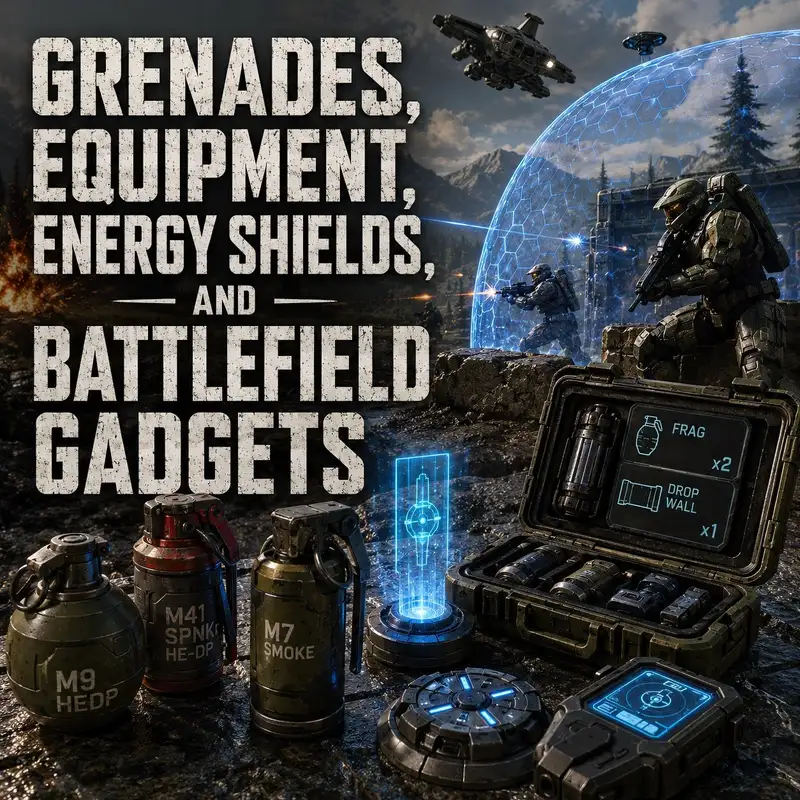
Grenades, Equipment, Energy Shields, and Battlefield Gadgets
John-117 found Vedrana Makovich after the battle she had been sent to fight was already over. Her Mjolnir armor still carried a functioning drop wall module. The Weapon identified it, the Master Chief removed it, and another Spartan’s equipment entered his own combat system. On Zeta Halo, there was no depot issuing replacements and no orderly transfer of property. A dead soldier’s defensive device became a living soldier’s next chance to survive.
That moment explains why grenades, shields, and battlefield gadgets matter. A rifle determines how a soldier attacks a visible target. Equipment changes the conditions under which that attack occurs. It can create cover where none existed, reveal an enemy behind concealment, collapse a shield, deny a passage, cross a vertical obstacle, or buy several seconds for a wounded unit to move. Those seconds are often more important than another magazine.
The simplest device in this category is also one of the oldest. The M nine high-explosive, dual-purpose grenade served across the branches of the United Nations Space Command for centuries. Soldiers usually called it a fragmentation grenade, though the M nine designation covered several production models built at different plants. The underlying idea changed little. A compact explosive body could place lethal fragments into a position that direct fire could not reach.
That gave infantry a form of portable indirect fire. A grenade could be bounced around a corner, rolled beneath a vehicle, dropped through an opening, or thrown behind cover. The user did not need to see the target at the instant of detonation. He needed to understand geometry, timing, and where the fragments would travel. A poor throw wasted ammunition. A worse throw returned the problem to the squad that had tried to solve it.
Fragmentation also made the M nine dangerous in the environments where Halo’s close wars were often fought. Ship passages, urban rooms, maintenance spaces, and bunkers reflected fragments and blast through confined areas. A grenade might clear a firing point while damaging pressure seals, power conduits, medical equipment, or civilians on the other side of a wall. The explosive did not know which parts of the compartment the boarding party hoped to keep.
The plasma grenade used a very different technology to answer the same tactical requirement. Covenant versions contained a compact source of plasma inside a smart-matter casing that could adhere to infantry, vehicles, and other suitable targets. Once attached, the device detonated after a short delay and released a concentrated burst of thermal energy. The target could see the blue light, understand what had happened, and still have almost no useful response.
Adhesion changed the grenade from an area weapon into a temporary attachment charge. A miss might still force troops away from cover. A successful stick carried the explosive wherever the target moved. Against a vehicle, that could place the blast directly against armor or an exposed system. Against shielded infantry, it prevented the target from escaping the center of the detonation. The weapon was elegant, efficient, and deeply unpopular among everyone asked to remove one by hand.
Plasma grenades also demonstrated Covenant logistical maturity. They were sophisticated energy devices, yet common enough to reach ordinary infantry in great numbers. They required specialized manufacture, storage, and distribution, but not the crates of chemically propelled ammunition used by human grenades. Human troops could capture and throw them immediately. Replacing or repairing them remained dependent on alien matériel and whatever the battlefield provided.
The Jiralhanae spike grenade made adhesion more mechanical. Blades on the casing allowed it to embed in a person, vehicle, or surface before detonation. It then drove superheated spikes and fragments outward with particular danger in confined terrain. The result blurred the distinction between grenade and limpet mine. A soldier could survive the initial impact and still have only moments before the device completed the attack.
Spike grenades reflected a Jiralhanae preference for weapons that combined simple physical force with an unmistakable psychological message. They were effective against personnel, useful for route denial, and dangerous to anyone standing near the attached target. Their directional fragmentation made placement important. A careless user could waste much of the effect into open space or send it through friendly troops. Brutality did not eliminate geometry.
Other grenades attacked the battlefield rather than one body. Jiralhanae firebombs spread incendiary material across an area, driving defenders from rooms and denying routes. Banished dynamo grenades released repeated electrical arcs that could damage personnel, interfere with shields, and disrupt nearby systems. These weapons were valuable because they forced movement. A commander could make a doorway, vehicle bay, or piece of cover temporarily unusable without destroying the entire structure.
That distinction matters in occupation and boarding operations. An army often needs to take a position intact. It may want the prisoners, machinery, data, or Forerunner artifact inside. Incendiary and electrical devices allow an assault force to shape movement before entering. They also carry obvious risks. Fire spreads. Electrical effects reach friendly equipment. A grenade intended to clear a passage can turn the passage into a hazard for the troops ordered to advance through it.
Grenades therefore belong to doctrine, not merely to a soldier’s belt. Units train who throws, who covers, when the assault follows, and how friendly personnel are warned. They count grenades because every device occupies weight and storage that might otherwise carry rifle ammunition, medical supplies, batteries, or demolition charges. The most useful grenade is not always the most destructive. It is the one whose effect matches what the unit must do after it explodes.
Energy shielding changed every part of that calculation. A shield is a network of generators creating overlapping fields that reflect, dissipate, or absorb attacks. It does not make the user invulnerable. It creates an additional defensive layer that can be weakened, overloaded, allowed to recover, or attacked by a system designed specifically to disrupt it. Armor remains necessary beneath the field because the shield will eventually fail.
The Covenant distributed shielding according to species, role, and status. Sangheili combat harnesses commonly carried full-body rechargeable shields, with stronger systems often associated with higher rank or specialized duty. Kig-Yar point-defense gauntlets projected a directional shield large enough to cover much of the user from the front. Other privileged troops received shielding when their assignments justified it. Technology reinforced the Covenant hierarchy as clearly as armor color or weapon issue.
The Kig-Yar shield illustrates the difference between protection and invulnerability. From the front, the gauntlet could absorb small-arms fire that would kill an unshielded soldier. The user’s weapon hand, legs, sides, and rear remained potential targets. Human troops learned to change angle, use grenades, strike exposed areas, or overwhelm the field with concentrated fire. The shield controlled where the enemy wanted to shoot. It did not control where a disciplined fire team could maneuver.
Sangheili shields created a different tactical rhythm. A warrior could cross exposed ground, survive initial hits, and close with a weapon that would have been too risky for unshielded infantry. Once the field weakened, the Sangheili needed cover, support, or enough aggression to end the engagement before the protection collapsed. Human units responded with concentrated volleys, plasma overcharges, grenades, and precision fire timed for the instant after shield failure.
This is one reason Halo firefights often turn on sequence rather than raw damage. One weapon strips protection. Another exploits the opening. A grenade forces movement. A marksman fires as the target leaves cover. The shield gives its wearer time, but it also creates a visible cycle that trained opponents can read. Survival depends on how the user spends the protected seconds and what the supporting unit does while the field recovers.
Humanity spent much of the Covenant War trying to reproduce that advantage. Research teams examined captured shield technology, including Kig-Yar gauntlets, for nearly two decades. The breakthrough reached Mjolnir in the Mark Five generation in late twenty-five fifty-one. For the first time, Spartan armor could fully integrate rechargeable energy shielding as a standard capability rather than rely solely on advanced physical protection and speed.
That achievement did not place humanity on technological parity with the Covenant. Energy shielding remained expensive, power-hungry, and closely tied to Mjolnir’s already demanding maintenance system. Ordinary Marines and Army personnel did not suddenly receive personal shields. A damaged emitter, failed power system, or compromised suit could remove the advantage. The armor plating beneath the shield remained essential, as did technicians capable of keeping the entire assembly operational.
Personal shields also created new vulnerabilities. Plasma weapons could strip them efficiently. Electromagnetic attacks could disable them. Repeated kinetic fire could overload them. A soldier who trusted the field more than cover could be caught in the open when it failed. Mjolnir made Spartans harder to kill. It did not make tactical judgment optional, despite occasional procurement language that seemed eager to test the possibility.
Temporary overshield modules extended protection beyond the armor’s normal limit. Office of Naval Intelligence research into captured Covenant devices eventually produced quick-application modules that could reinforce a user’s shielding for a limited period. These were useful for crossing a kill zone, beginning an assault, or surviving the first exchange with a heavily armed enemy. They were not a permanent improvement to every suit and did not remove the need to recharge, replace, and supply the module.
Active camouflage followed a similar path. Covenant harnesses had used optical concealment for special operations, infiltration, and assassination. Human programs reverse-engineered versions for specialized Spartan missions and later integrated portable modules with Mjolnir. The effect bent or reproduced the surrounding image around the wearer. Movement, weapons fire, environmental disturbance, and opposing sensors could still reveal the user. Camouflage reduced detection. It did not grant permission to walk through a guarded doorway while carrying a brightly glowing energy sword.
Deployable shields moved protection away from the individual body and into the terrain. The bubble shield was based on Forerunner technology, and the Office of Naval Intelligence manufactured examples after recovering earlier devices. Similar spherical shields appeared in the hands of Jiralhanae forces during the final battles of the Human-Covenant War. Once activated, the generator created temporary all-around protection from incoming fire.
The bubble’s strength was also its weakness. It blocked fire in both directions, while personnel and vehicles could pass through the field. A unit inside gained a pause from distant attack but surrendered the ability to shoot out. An aggressive enemy could enter. A grenade thrown through the boundary turned the protected space into a confined explosive chamber. The generator itself could be damaged, moved, or destroyed. The shield created cover, not a fortress.
Human drop shields refined the concept for specialized use. They projected a defensive dome and produced a regenerative effect that remained incompletely understood during twenty-five fifty-two. The field could be broken by sufficient damage. Later drop walls created one-sided, segmented protection that allowed friendly fire to pass outward while absorbing attacks from the front. Each section could fail independently, giving the user warning that the position was becoming unsafe.
The drop wall exchanged complete enclosure for fire superiority. A Spartan could deploy it in an exposed passage, fire through the protected side, and move before the remaining segments collapsed. It was useful for casualty protection, a hasty firing point, or the first seconds of a breach. It remained temporary. The enemy could flank it, overwhelm it, attack from above, or simply wait for the projector to fail.
Shield technology inevitably produced shield-countering equipment. The Covenant power drain created a short-lived electromagnetic field that disabled energy shields and interfered with light vehicles and nearby electronics. Jiralhanae loyalists used it heavily during the final weeks of the war, and human troops were willing to use captured examples. A single device could remove the protection that had justified an exposed position and leave several advanced systems failing at once.
The power drain’s value came from timing. Thrown too early, it warned the enemy and exhausted itself before the assault arrived. Thrown into the right position, it collapsed shields, disrupted mobility, and created a brief window for conventional fire. It also threatened friendly electronics and captured equipment. The field did not distinguish between a Spartan’s shield and a Covenant system the Spartan hoped to recover intact.
Other support devices attacked information and movement. Radar jammers corrupted motion-tracker returns, forcing troops to rely on sight, sound, and direct communication. Flares overwhelmed visual systems and created confusion during an approach. Portable gravity lifts moved personnel and matériel over walls, onto platforms, or through vertical shafts. Trip mines denied routes and threatened vehicles. None was as celebrated as a rifle. Each could decide whether the rifle reached the right position.
These devices were especially valuable aboard ships and installations, where geometry controlled the battle. A portable lift could bypass a defended stairwell. A jammer could hide movement behind a bulkhead. A deployable cover emitter could turn an open passage into a firing position. A mine could delay pursuit long enough for a boarding team to reach extraction. Equipment changed the map at the scale a squad could carry.
The postwar United Nations Space Command increasingly integrated that logic into Mjolnir. The grappleshot grew from Project Magnes, begun by a civilian engineer during the Covenant War and later adapted into a wrist-mounted system compatible with Generation Three armor. It could pull the user toward an anchor, retrieve an object, or rapidly alter movement across broken terrain. On Zeta Halo, where bridges, cliffs, wreckage, and fractured structures dominated the battlefield, that mobility was unusually valuable.
The grappleshot did not turn a Spartan into an aircraft. It required a suitable anchor, a clear path, a functioning mechanism, and armor able to manage the forces involved. The same acceleration that moved an augmented soldier across a gap could injure an unprotected operator. It was a mobility tool designed around Mjolnir strength and control, not a universal replacement for ladders, lifts, or dropships.
The threat sensor treated information as equipment. Fired from the wrist, it could attach to a surface, vehicle, or target and pulse the surrounding area. Enemies within its coverage appeared on friendly displays, including opponents using active camouflage or hiding behind cover. A fire team could place one before entering a room, attach it to a retreating vehicle, or expose an ambush without sending a person forward first.
A sensor result still required interpretation. The device could be destroyed, avoided, deceived, or placed where walls and distance reduced its value. It revealed presence, not intention. It did not identify every decoy, explain the enemy plan, or tell the squad whether the highlighted figure was the most important target. Information gained quickly is useful. Information believed without judgment is merely a faster way to make a mistake.
The repulsor gave a soldier a directional anti-gravity burst. It could deflect grenades and rockets, throw personnel away from a position, or move battlefield objects. The device changed defense from passive absorption into active redirection. Its effectiveness depended on timing and orientation. A burst used against the first projectile might leave the user without an answer to the second.
Thruster modules solved another small but decisive problem. They produced short directional bursts that allowed a Spartan to evade fire, cross a gap, or change position faster than an enemy expected. They were not full flight systems. Their value lay in breaking the opponent’s firing solution during the fraction of a second in which a rocket, beam, or hammer strike would otherwise connect.
Zeta Halo turned these modules into battlefield inheritance. John recovered a threat sensor from Hudson Griffin’s armor, enhanced shielding from Bonita Stone, the drop wall from Makovich, and a thruster module from Theodore Sorel. The sequence should not be read as a convenient supply catalog arranged for one soldier. It was the remains of a shattered Spartan force, redistributed because the surviving campaign had no normal replacement system.
The Banished understood the same lesson from the other side. Their forces captured human equipment, studied it, and repurposed what they could. Human mercenaries working within the Banished produced the Threat Seeker from United Nations Space Command sensor technology, simplifying the device for mass production and the needs of their employers. Battlefield gadgets crossed political lines because a useful pulse, shield, or burst of gravity carried no loyalty of its own.
Not every device seen in training simulations became standard field equipment. Some remained prototypes, specialist modules, or technology dependent on scarce components and artificial-intelligence support. The quantum translocator, for example, used small-scale slipspace effects but remained far from routine issue for transporting organic personnel. A working demonstration is evidence of technical progress. It is not evidence that the quartermaster has one for every fire team.
Equipment also creates a burden before it creates an advantage. Every module needs power, maintenance, software compatibility, inspection, and training. Carrying one may mean carrying fewer grenades or less medical gear. A shield projector must be placed correctly. A sensor must be linked to the squad’s displays. A grappleshot must be trusted with the user’s full weight. A device that fails at the wrong moment can be more dangerous than never having it.
That is why these systems matter beyond their individual effects. They show armies trying to control the few meters and seconds that decide close combat. Grenades attack cover. Shields buy time. Power drains take that time away. Sensors replace uncertainty with a temporary picture. Mobility devices create angles the enemy did not prepare to defend. None wins a campaign alone, but each can decide whether a squad reaches the next room, vehicle, or extraction point.
Makovich’s drop wall did not save her. It still mattered after her death because another soldier could integrate it and continue the fight. That is the defining contradiction of Halo’s battlefield equipment. The device is temporary, expendable, and often carried by one person. The advantage it creates may last only seconds. Those seconds can outlive the person who brought them.