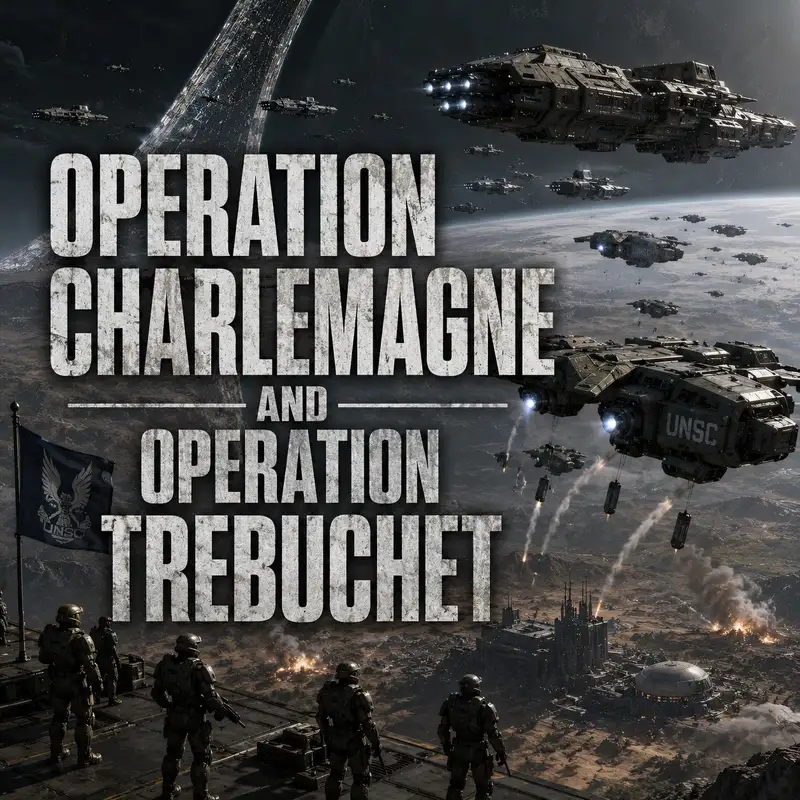
Operation CHARLEMAGNE and Operation TREBUCHET
The Eridanus government asked for help in December of twenty-four ninety-four. The major counterattack did not arrive until January of twenty-four ninety-six. By then, Colonel Robert Watts and the Secessionist Union had controlled Eridanus Two for roughly a year, disrupted its shipping, murdered political opponents, and built a small fleet with help from sympathizers inside the colonial military. The delay did not mean the Unified Earth Government had ignored the colony. Interstellar counterinsurgency required ships to be recalled, forces assembled, intelligence developed, and political authority converted into something able to survive contact with an armed system.
Operation Charlemagne retook Eridanus Two. Operation Trebuchet began seventeen years later because that victory had not solved the war. Together, the two campaigns reveal the central weakness of the Unified Earth Government’s response to the Insurrection. It could concentrate enough force to defeat rebels in open battle, seize cities, and restore an approved government. It could not reliably prevent surviving leaders from escaping, rebuilding their networks, and returning after the fleet departed. Charlemagne was a successful counterattack. Trebuchet became a far-ranging effort to pacify human space. The distance between those descriptions is where the strategic failure occurred.
Robert Watts understood the government’s problem because he had once served inside its military system. A former United Nations Space Command Marine colonel, he brought professional experience to a movement that contained activists, local militias, clandestine cells, smugglers, and armed separatists of uneven quality. In June of twenty-four ninety-four, he helped organize a coordinated uprising on Eridanus Two. Bombings, assassinations, and kidnappings weakened the colonial government and damaged the shipping industry. Rebel sympathizers within the Colonial Military Authority helped provide contracts, equipment, and access sufficient for the insurgents to assemble armed spacecraft rather than merely hide weapons in cargo holds.
By January of twenty-four ninety-five, the rebels effectively controlled the colony. That created three connected military problems. The Navy had to defeat a local space force and reopen access to the planet. Ground forces had to break the insurgents’ control of political centers and military facilities. Intelligence organizations had to identify leaders, supply networks, and collaborators without assuming that every citizen, official, or colonial soldier was an insurgent. The first two problems could be addressed with concentrated force. The third required persistent knowledge and political legitimacy. Charlemagne would perform best where the target was visible and worst where the enemy could disappear into society or space.
Planning was underway by March of twenty-four ninety-five, but building the required battle group took time. Ships assigned to distant patrols could not be summoned like aircraft from a neighboring base. They had to receive orders, finish or abandon existing missions, move through slipspace, rendezvous despite uncertain travel times, replenish, and integrate under a common commander. The government was trying to mass naval power across an interstellar network designed primarily for commerce, colonization, and routine security. The delay gave Watts time to consolidate. It also showed every colony watching the crisis that central authority could be overwhelming once assembled and remarkably absent before then.
On January twelfth, twenty-four ninety-six, the United Nations Space Command launched Operation Charlemagne. A Navy battle group entered the Eridanus theater and engaged the insurgent fleet above Eridanus Two. The surviving record does not provide a complete order of battle, so precise ship counts and formations should not be invented. Four destroyers were lost while the battle group broke rebel space resistance and restored military access to the planet. That casualty figure is important. The enemy was not a peer navy, but it was dangerous enough to destroy capital ships during a campaign later summarized as a decisive government victory.
Naval control made the ground campaign possible, but it did not make it simple. Follow-on counteroperations attacked insurgent positions, disrupted command relationships, and eliminated leaders from factions allied with Watts. Removing those leaders splintered parts of the coalition and reduced its ability to govern openly. It also created leaderless organizations whose surviving personnel could be absorbed by whoever retained the strongest network. Decapitation can disorganize an insurgency. It can also clear the competition for the commander who escapes. Charlemagne damaged Watts’s alliance without capturing Watts, leaving him with fewer rivals and a pool of angry survivors.
The newly revived Orion project received its first tactical deployment during Charlemagne. The entire Orion unit was inserted without public detection, struck insurgent forces, and destroyed a rebel military base. One Orion operator became a casualty. The remaining personnel were extracted without being seen by surviving witnesses. This was a remarkable special-operations success. It also demonstrated the limit of elite action. The Orion force could destroy a base and leave almost no visible footprint. It could not occupy the colony, monitor every port, or replace the political order that had collapsed.
Charlemagne continued into twenty-four ninety-seven. During that period, Marine forces fielded the S P forty-two Cobra for the first time, adding a mobile anti-armor and direct-fire system to operations on the surface. New equipment, naval concentration, leadership targeting, and augmented operators all contributed to the same result. The Unified Earth Government regained Eridanus Two. Rebel formations suffered heavy losses. The campaign achieved its immediate operational objective. A map in a command center could once again display the colony under government control, which is useful so long as no one mistakes the symbol for the complete political situation below it.
Watts and many of his followers escaped into the Eridanus system’s asteroid belt. That withdrawal preserved the most valuable insurgent resources: leadership, experienced personnel, contacts, technical knowledge, and a narrative of survival. An asteroid belt offered concealment on a scale that no city district could match. Habitats, mined rocks, civilian traffic, hidden depots, and innumerable sensor shadows complicated search operations. The Navy could patrol known routes and inspect ships, but permanent coverage demanded more vessels than any government could spare. The rebels did not need to control the belt in a conventional sense. They needed enough places where the government could not prove they were present.
The surviving insurgent factions reorganized under Watts and gradually became the United Rebel Front. This was Charlemagne’s central strategic contradiction. Government forces had destroyed much of the coalition’s visible structure, but the leader who escaped gathered remnants into a more recognizable organization. The operation retook the colony while helping define the enemy that would contest it again. This does not mean the United Nations Space Command created the United Rebel Front. Watts, his supporters, and the grievances sustaining them were responsible for their own decisions. It means that military success altered the rebel movement rather than ending it.
Charlemagne also accelerated the crisis inside the Colonial Military Authority. Evidence that colonial officials had supported the rebels made locally recruited forces appear unreliable to Earth-centered commands. Subsequent counterintelligence operations exposed deeper sympathies in senior offices, and the United Nations Space Command absorbed increasing portions of the colonial military’s authority, ships, and infrastructure. The security logic was straightforward. A compromised organization could not safely control depots, contracts, or mobilization plans. The political effect was equally predictable. Colonial personnel who remained loyal saw their institution stripped of prestige and resources, while separatists described the takeover as proof that local military authority existed only until Earth distrusted it.
For the next several years, targeted operations, patrols, arrests, and clandestine strikes kept pressure on insurgent networks. The Orion project proved tactically capable but expensive and medically imperfect. It was unofficially terminated in twenty-five oh six, with surviving operators dispersed into other assignments. The government retained the people and knowledge it found useful while abandoning the idea that one augmented unit could close the widening political fracture. By twenty-five thirteen, Watts had rebuilt enough strength to challenge Eridanus Two again. The government had won time. The rebels had used it.
Watts’s second bid for Eridanus Two was more ambitious than a raid. He intended to use the colony as a base for the United Rebel Front and draw the colonial military into a costly guerrilla struggle. Fighting spread through the system as separatists attempted to break from Unified Earth Government control. The rebels assembled at least one hundred smaller craft, many adapted from civilian use, and attempted to create a local navy. Their fleet did not need to defeat every government warship. It needed to threaten traffic, move personnel, complicate reinforcement, and demonstrate that the rebellion could contest access to an entire system.
The United Nations Space Command anticipated the uprising and responded with carriers, cruisers, and destroyers. In open space, the difference between an improvised rebel fleet and a professional navy became decisive. Civilian hulls could carry weapons and crews, but they generally lacked the armor, fire-control integration, damage control, trained formations, and logistical support of purpose-built warships. The government fleet defeated the rebel vessels in open space. This was not evidence that the insurgents had become harmless. It showed that their naval strength depended on surprise, concealment, dispersal, and asymmetric attack rather than a sustained fleet engagement against concentrated regular forces.
On the surface, units of the Ninth Marine Expeditionary Force entered a different kind of battle. Their mission was not merely to defeat armed formations. They were expected to capture leaders, protect infrastructure, separate insurgents from the population, and restore a government whose legitimacy remained contested. First Battalion of the Twenty-First Marine Division, commanded by Lieutenant Colonel Ponder, took part in an operation in Elysium City aimed at capturing a senior rebel figure. The mission ended with a grenade, dead family members, a wounded commander, and a disciplinary judgment shaped by seconds of uncertainty. Urban counterinsurgency rarely offers the clean target picture promised in a briefing.
The United Rebel Front failed to establish a secure stronghold on Eridanus Two. Government forces destroyed much of its organized presence, and Watts ordered a withdrawal. Rebel ships fled the planet, were pursued by the Navy, and escaped through slipspace. The remnants regrouped in the system’s largest asteroid belt and developed the hidden settlement known as Eridanus Secundus. Seventeen years after Charlemagne, the same operational pattern had repeated. The government won above the planet and across its major population centers. The insurgent leadership survived by abandoning territory before its destruction became unavoidable.
Operation Trebuchet grew from that campaign into a broad counterinsurgency lasting more than a decade. It involved Navy vessels, Marine units, special warfare personnel, intelligence organizations, colonial forces, and local authorities across multiple systems. Its scope was both a strength and a serious weakness. A central command could move forces toward major crises and pressure networks that crossed colonial borders. It also placed widely different movements under one military framework. Peaceful separatists, local rioters, armed guerrillas, bomb makers, smugglers, and organized terrorists could all appear inside the same operational picture even when their motives and methods differed.
The word pacification carried much of the problem. It described a desired condition without defining the political arrangement that would sustain it. A colony could be called pacified when attacks declined, leaders were arrested, and government offices reopened. None of those measures proved that residents accepted the authority being restored. When a fleet departed, local officials still had to govern. When Marines left a district, police and courts still had to function. When commerce resumed, workers and corporations still disputed wages, extraction, and representation. Trebuchet could suppress symptoms faster than civilian institutions could resolve causes.
The campaign imposed a significant naval burden. Counterinsurgency required patrol vessels, troop transports, command ships, reconnaissance, boarding teams, and enough repair capacity to keep widely dispersed forces operational. Following the exposure of colonial military infiltration, the Navy had to assume responsibilities for which it lacked sufficient command-and-control hulls. Older Valiant-class designs were revived and converted to support battle groups tied down by lengthy expeditionary operations. Even then, resource and crew shortages prevented every ship from receiving the planned upgrades. The fleet was expanding its authority faster than industry could provide fully equipped vessels and trained personnel.
This mattered because presence, not firepower, was the scarce resource. A cruiser could destroy an insurgent ship if it found one. It could not inspect every cargo transfer across several systems. A Marine battalion could raid a suspected bomb shop. It could not remain on every street after the raid ended. Intelligence officers could penetrate one cell while missing another organized through family, labor, or commercial ties. Trebuchet’s units faced the same arithmetic. The government had more destructive power than the rebels. The rebels had more possible places to hide than the government had forces to search.
The operation reached into the Inner Colony system of Epsilon Eridani, including the industrial world Tribute. By twenty-five twenty-four, major insurgent cells were operating among dense populations and strategically important infrastructure. A Marine battalion, a corvette, and air support conducted raids while bombings and assassinations continued. During one operation, special warfare teams led by Avery Johnson and Nolan Byrne attacked insurgent bomb makers. The immediate target was found, but a vehicle carrying explosives escaped to Casbah City. Hesitation, competing judgments, and a detonation at a crowded restaurant killed Marines and civilians. Tactical contact with the enemy had not protected the population.
That incident shows why casualty figures alone cannot explain Trebuchet. A contemporary account placed those caught in the operation’s crossfire above one million by twenty-five twenty-four. The record does not provide a complete breakdown of insurgents, government personnel, and civilians within that estimate. The political meaning was clearer. Each bombing allowed the government to argue that stronger security was necessary. Each raid that killed bystanders allowed insurgents to argue that government security was itself the threat. Both sides could point to real bodies. Neither side could convert those bodies into a stable settlement.
Insurgent violence also cost rebel groups support. On Tribute, attacks that endangered ordinary residents weakened the popularity of cells that had initially benefited from local sympathy. Separatism did not require approval of terrorism, and many colonists who distrusted Earth still rejected bombings in civilian areas. The government’s mistake was often to treat declining support for one violent cell as increasing support for central rule. A population could oppose insurgent murder and still resent military raids, censorship, economic control, and distant political authority. Counterinsurgency offered few reliable ways to measure that difference.
Information management became part of the campaign. Authorities concealed some attacks, including the destruction of a civilian liner near Reach, by presenting them publicly as accidents. Secrecy could prevent panic, protect an investigation, or deny terrorists publicity. It could also convince citizens that official casualty reports were designed to manage perception rather than reveal events. Insurgents used propaganda of their own, magnifying genuine abuses and presenting every enforcement action as occupation. Trebuchet was fought through patrol routes and arrest lists, but also through competing explanations of who had started the violence and who was keeping it alive.
The colonial military’s remaining personnel often occupied the worst position in that contest. They were locally recruited, poorly resourced, distrusted by the United Nations Space Command, and still expected to perform riot control and other politically sensitive missions. Some units remained professional. Some personnel sympathized with separatists. Others simply resented being given deteriorating equipment while regular forces absorbed their best ships and assignments. An angry crowd saw colonial troops as the face of government coercion. Regular commanders sometimes saw the same troops as a security risk. That is an efficient way to create bitterness and a poor way to build a reliable partner force.
Trebuchet did produce military adaptation. Boarding procedures, mobile response forces, command ships, and special-operations methods evolved under the demands of a dispersed human conflict. It trained officers and enlisted personnel in urban operations, interdiction, intelligence support, and fighting aboard ships. It also consumed readiness. Ships accumulated wear. Crews remained deployed. Experienced personnel were lost or injured in actions that rarely changed the strategic balance. The United Nations Space Command entered twenty-five twenty-five with a military hardened by counterinsurgency but organized around an enemy whose strongest weapons were bombs, stolen vessels, and political concealment.
On February third, twenty-five twenty-five, the larger strategic framework collapsed. Contact with the Covenant at Harvest introduced an enemy whose objective was not colonial autonomy, leverage, or even control of human government. It was the destruction of humanity. Operation Trebuchet was suspended rather than formally completed. Many Insurrectionists stopped fighting the United Nations Space Command, cooperated when necessary, or hid from both sides. Others continued to resist. The Covenant destroyed Outer Colonies so thoroughly that it eliminated communities, grievances, government offices, rebel networks, and civilians without distinguishing among them. Genocide accomplished what counterinsurgency could not, but calling that a government victory would empty the word of meaning.
Charlemagne and Trebuchet were therefore not two versions of the same operation. Charlemagne was a bounded campaign to retake a specific colony from an identifiable coalition. It succeeded because the United Nations Space Command could mass naval and ground power against visible objectives. Trebuchet was an expanding effort to impose security across many colonies, systems, and political movements. It could win engagements, capture leaders, and disrupt cells. Its objective receded whenever violence moved elsewhere, whenever survivors reorganized, or whenever a raid created more hostility than intelligence.
The two operations are linked by the survival of Robert Watts and by a repeated confusion between control and resolution. Charlemagne restored Eridanus Two but allowed the insurgent command network to escape. Trebuchet defeated the second uprising but again drove the rebels into hidden bases rather than eliminating the movement. The government repeatedly held the planet. The rebels repeatedly preserved enough freedom in the spaces between planets to continue the war. Naval victory provided access. Ground victory provided temporary control. Neither automatically produced consent.
Their lasting consequence was institutional. The Navy expanded, the colonial military declined, intelligence authorities gained influence, and augmented soldiers became increasingly attractive as tools for a conflict conventional forces could not close. The military system later used to resist the Covenant was shaped by operations against human colonies. That preparation saved lives during the war of extinction. It did not retroactively settle whether every earlier deployment was wise, lawful, or politically sustainable.
The clearest image is not the recaptured government building on Eridanus Two. It is the interval between the request for help and the arriving fleet, followed years later by another rebel withdrawal into the same asteroid belt. Operation Charlemagne proved that the Unified Earth Government could retake a colony. Operation Trebuchet proved that retaking colonies was not the same as governing them. The Insurrection endured because ships could cross slipspace faster than political trust, and no battle group carried enough of the latter to occupy every world it was ordered to save.