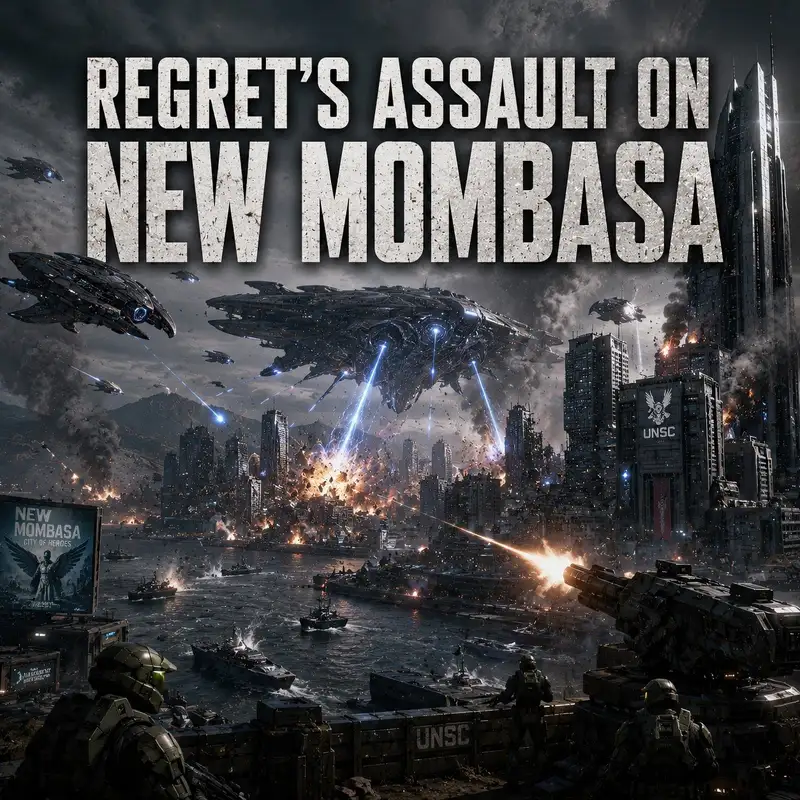
Regret’s Assault on New Mombasa
Regret’s most consequential decision came after he learned that the world beneath him was not an undefended Forerunner site. It was Earth. The Fleet of Sacred Consecration had already lost ships breaking through the planet’s orbital defenses, including one of its two assault carriers. The remaining flagship, Solemn Penance, could have withdrawn while the Home Fleet was still reorganizing. Instead, the High Prophet ordered it toward New Mombasa. At fourteen fifty-nine hours on October twentieth, twenty-five fifty-two, the carrier emerged over the Uplift Nature Reserve and began deploying troops into the only city on Earth the Covenant had chosen to occupy.
The assault did not begin as a planned invasion of humanity’s homeworld. Regret had recovered Forerunner navigation data from a Luminary found on Meridian. The information pointed toward a world the Covenant knew as Erde-Tyrene and identified a portal connected to the Ark, a site central to Covenant expectations about the Great Journey. Regret moved quickly with a hastily assembled force of fifteen warships. His decision reflected religious urgency, political ambition, and a familiar Covenant assumption that any population standing between a Hierarch and a Forerunner relic could be removed by force. He expected an archaeological seizure supported by a fleet. He arrived at the most heavily defended human world in existence.
That error explains both the violence and the brevity of Regret’s ground campaign. He did not possess the force required to conquer Earth, defeat its entire Home Fleet, occupy multiple continents, and suppress its population. He did possess an assault carrier able to deploy thousands of troops, aircraft, armor, and specialized personnel directly over one objective. Solemn Penance was not a substitute for an invasion armada. It was more than sufficient to turn one city into a battlefield while the rest of Regret’s fleet absorbed the orbital defense.
New Mombasa was a particularly dangerous place to attempt that kind of limited seizure. The city was a major port and industrial center in the East African Protectorate. New Mombasa occupied the island, while districts collectively known as Old Mombasa extended across the surrounding mainland. The Mombasa Tether dominated the skyline and connected the city’s ground infrastructure with orbital transportation. Roads, maglev lines, canals, tunnels, ports, and elevated structures made the city economically efficient. They also created a dense network of military objectives. A carrier positioned above the tether could threaten transportation, communications, evacuation, and orbital access at the same time.
The city’s infrastructure was managed in part by the Superintendent, a second-generation urban artificial intelligence. It controlled traffic systems, municipal services, cameras, public information, and access through a city designed to move people and cargo continuously. None of those systems had been built for an assault carrier hovering above a nature reserve. The Superintendent could redirect traffic, warn civilians, and preserve fragments of the municipal network. It could not order the carrier to leave, although its surviving traffic logic appears to have regarded the vessel as an unusually severe parking violation.
Regret’s immediate objective was the Forerunner portal buried beneath the Mombasa region. The problem was that neither he nor his ground commanders possessed a complete map of the structure. The coordinates brought the fleet to the correct area, not to a convenient control panel waiting in an empty field. Covenant troops therefore had to secure terrain, investigate subsurface access, protect Huragok engineers, and prevent human forces from interfering while the carrier remained exposed above them. This was an excavation mission operating under the conditions of an urban combined-arms battle.
Rhul ‘Salmutee, the shipmaster responsible for Solemn Penance, deployed infantry and mechanized support around the Uplift Nature Reserve, Old Mombasa, and the approaches to the city center. Phantoms and Spirits moved troops between strongpoints. Banshees contested the air corridors between towers. Ghosts and Wraiths controlled roads and open ground. Scarab platforms advanced toward the Mombasa Tether and other hardened positions. Specialized Kig-Yar marksmen from the Jha’kaar were placed where long streets and elevated sight lines favored them. The assault force was mixed because its mission required more than killing defenders. It had to clear, hold, search, and then extract.
The first targets reveal the operational logic. Covenant armor struck the maglev network, disrupting civilian movement and military reinforcement. Forces concentrated beneath the carrier to protect the landing zone. Scarabs moved through both Old and New Mombasa, threatening the tether and breaking positions that ordinary infantry could not reduce quickly. Huragok were sent into the Kikowani subway area, likely searching for routes or data connected to the buried Forerunner complex. The Covenant was attacking a city and interrogating it at the same time.
New Mombasa’s local defenders were not prepared to repel a Covenant assault carrier on their own. Police units, Marines, Army personnel, and recently reinforced military detachments were present, but the city had not been converted into a planetary fortress. Earth’s main defensive strength remained in orbit. Once Solemn Penance reached the surface, that strength became difficult to apply. A magnetic accelerator round or heavy missile strike against a carrier hovering over a populated city might destroy the target and much of the city with it. Regret had not taken the civilian population hostage through a formal threat. His position created the same practical limitation.
Civilians discovered the invasion through interrupted trains, emergency broadcasts, traffic failures, and Covenant weapons appearing among familiar streets. The tether was shut down, removing one of the city’s most important escape and transport systems. People moved by road, on foot, and by boat toward routes that had not yet been cut. Some armed themselves and fought beside Marines. Public broadcasts exaggerated militia successes to sustain morale, a useful reminder that information operations do not become more accurate merely because the city issuing them is actually under attack. The reports may have been embellished. The danger was not.
The attack on the maglev system illustrated how quickly military and civilian problems merged. A train forced to stop became a crowd without transport. A destroyed station became an obstacle to reinforcement and evacuation. A Wraith firing at a transit corridor could isolate a district as effectively as a demolished bridge. The same municipal network that allowed the Superintendent to monitor movement also gave Covenant forces predictable routes to block. Urban infrastructure provided efficiency in peace and concentration under fire.
Human commanders soon learned that the High Prophet of Regret was aboard Solemn Penance. An intercepted Covenant transmission identified the Hierarch and indicated that he was requesting support. Fleet Admiral Terrence Hood immediately recognized the opportunity. The Covenant had landed nowhere else on Earth, and its most senior surviving leader was directly above New Mombasa. Capturing him might reveal why the fleet had come, provide political leverage, and accomplish a version of the objective once assigned to Operation Red Flag. The ground campaign was therefore organized around reaching the carrier, not merely clearing streets.
Commander Miranda Keyes brought the light frigate In Amber Clad into the theater with Marines, vehicles, and John-One One Seven. The frigate could move reinforcements rapidly and coordinate local air support, but it could not remain casually exposed beneath an assault carrier. Three Pelicans were sent toward Solemn Penance with the intention of reaching or boarding the ship. A Scarab intercepted the formation over Old Mombasa. One transport was destroyed. Another crashed near the beach. The third, carrying John and Avery Johnson, struck a building and came down inverted. Regret’s ground defenses had broken the most direct human approach before it reached the carrier.
The crashes forced the United Nations Space Command to rebuild the assault from the ground. Surviving Marines and Orbital Drop Shock Troopers established temporary positions around the Old Mombasa waterfront. Johnson was recalled to help coordinate the wider reinforcement effort, while John moved between isolated groups and the corridor leading toward New Mombasa. The Spartan was the most capable individual in the force. He still required Marines to hold intersections, Pelicans to move troops, Warthogs to carry weapons, and commanders aboard In Amber Clad to identify where his effort would matter.
Covenant marksmen, armor, and artillery had turned Old Mombasa’s streets and beaches into a layered delaying position. Human troops had to reopen routes before heavier forces could cross toward the island. The defenders at Hotel Zanzibar and nearby positions were not waiting for one soldier to win the battle for them. They were trying to keep a local command post alive long enough for separate landing groups to reconnect. Once those units linked, they could move from survival to counterattack.
The tunnel and bridge network became the decisive corridor. Covenant forces attempted to move vehicles through the same confined infrastructure the humans needed for reinforcement. Destroying that convoy and reopening the route allowed armor and infantry to advance toward New Mombasa. The bridge offered a direct approach, but also exposed vehicles to Wraiths, Ghosts, Banshees, and fixed positions. Scorpion tanks gave the human column the firepower to break through. They did not make it immune to plasma or the Scarabs operating ahead.
Once across the bridge, the human force entered a city where the Covenant was still establishing control. This timing mattered. Regret’s troops had landed widely, but they had not completed an occupation system. They held strongpoints, landing zones, transport routes, and the ground around the carrier. They did not control every building, tunnel, rooftop, or municipal access point. Human units could therefore bypass some positions, reinforce others, and exploit the city’s own internal routes. Urban terrain slowed the defenders and attackers alike. It also prevented the Covenant from converting orbital and air superiority into immediate control of every district.
The Scarab moving through New Mombasa became the central ground threat because it could break armored positions while advancing toward the tether. Conventional fire against its frontal armor achieved little. The platform destroyed a newly delivered Scorpion and continued into the canal system, where the surrounding walls restricted its maneuver. Pelicans and Marines applied pressure while John boarded the machine and eliminated its command crew. The kill depended on the city trapping a weapon designed for more open movement. A machine able to dominate a boulevard became vulnerable once its route narrowed and infantry could reach the hull.
The destruction of the Scarab did not annihilate Regret’s ground force. It removed the platform covering the withdrawal and demonstrated that the human counterattack had reached the center of the Covenant position. Marines were reinforcing the city. The carrier had lost most of its fleet support in orbit. Human commanders now knew who was aboard it and were concentrating forces accordingly. Regret’s expedition had ceased to be an excavation operation with local resistance. It had become a shrinking perimeter around a politically irreplaceable passenger.
Other human units were conducting intelligence operations inside the same battle. Orbital Drop Shock Troopers fought to recover a Forerunner device known as the Conduit after Covenant movements revealed its importance. Another force recovered Forerunner glyphs. The Office of Naval Intelligence designated exposed Huragok as high-value assets because their knowledge might explain the Covenant’s search. These actions did not drive the carrier out of the city, but they addressed the question Hood had identified at the start. The Covenant’s landing made little sense as an invasion. Its handling of artifacts and engineers showed that New Mombasa concealed something it considered more important than the city itself.
One Huragok, later known as Quick to Adjust, became especially valuable. Other Huragok freed it from the explosive harness used to enforce Covenant obedience, and the city’s Superintendent tracked it through a subroutine called Vergil. The immediate ground commanders did not yet possess the full intelligence this chain would eventually provide. That delay mattered. Human troops were fighting over the entrance to a Forerunner system before knowing where the system led. The Covenant understood the religious value of the target but not the political significance of the world above it. Both sides were operating with half of the correct answer.
Regret ordered a withdrawal when the tactical position became untenable. Solemn Penance moved toward the Mombasa Tether while surviving Covenant troops pulled back. Human forces had retaken much of the contested ground in roughly an hour, an impressive result against an assault carrier’s landing force. It was not a complete encirclement. The carrier remained mobile, shielded, and able to depart faster than human ground units could close every route to it.
Hood initially hesitated to send In Amber Clad directly against the carrier while it remained above the city. He preferred heavier ships to intercept if Solemn Penance returned to orbit. Miranda Keyes had a different immediate problem. If Regret left, the only senior Covenant leader ever isolated over Earth would disappear along with the best clue to the landing. When the carrier began preparing an atmospheric slipspace transition, Hood authorized pursuit. In Amber Clad moved after it without a confirmed destination solution, accepting the danger of an uncertain arrival rather than lose the target.
At the same time, the United Nations Space Command launched Operation Bumrush. Orbital Drop Shock Troopers from ships including the cruiser Say My Name descended toward Solemn Penance with orders to breach the carrier and force it down. The operation was approved at sixteen oh two hours. One minute later, Regret jumped. The timing transformed a difficult boarding assault into a mass casualty event. The carrier did not need to shoot down every pod. The electromagnetic pulse and overpressure from its transition disrupted navigation and safety systems while the troopers were already falling.
Most of the drop force was lost. Alpha-Nine survived because Captain Veronica Dare had redirected the squad away from the carrier toward a classified intelligence objective inside the city. That diversion scattered the team when the pulse struck, but it moved the pods far enough from the center of the event to preserve a chance of survival. Compartmentalization had complicated the mission. It also saved the only squad known to emerge from that particular drop as a functioning force, although functioning would be a generous description for personnel waking separately across an occupied city.
Solemn Penance entered slipspace only hundreds of meters above New Mombasa. The rupture generated a destructive pressure wave and electromagnetic pulse. Buildings were damaged, municipal electronics failed, aircraft and pods were thrown from controlled flight, and a large crater opened north of the city. Many structures remained standing, including the tether for a time, but the city’s integrated systems had been torn apart. The assault carrier escaped. Its departure inflicted damage that its ground force had failed to achieve through occupation.
The crater also exposed part of the Forerunner portal Regret had come to find. This was the central irony of the assault. His expedition failed to secure the objective and was driven from the city. His withdrawal physically revealed enough of the buried structure to make the Covenant’s next effort easier. A tactical retreat created the conditions for a larger excavation campaign.
Regret’s departure did not remove the Covenant from New Mombasa. Significant numbers of troops remained on the ground and in orbit. Some had been unable to reach the carrier. Others belonged to units already shifting under the authority of the Prophet of Truth. Jiralhanae forces received secret orders to eliminate Sangheili left behind, turning streets already contested by humans into an early battlefield of the political purge that would later erupt as the Great Schism. Regret’s assault ended with parts of his own army killing one another before humanity understood that the Covenant command structure was beginning to fracture.
Truth’s larger support and excavation fleet was already moving toward Earth. It had the mass Regret had failed to bring and a more deliberate purpose: secure the Mombasa region, expose the portal, and prepare access to the Ark. Human resistance continued through the city, led by Marines, police, Orbital Drop Shock Troopers, and surviving local systems. Alpha-Nine’s scattered fight, Dare’s search for the Huragok, and the Superintendent’s damaged network all belonged to the battle Regret left behind. His carrier was gone. His target remained.
The assault therefore produced a strange operational result. Regret lost most of his fleet, failed to hold New Mombasa, abandoned troops, and fled under human pressure. The United Nations Space Command failed to capture him, lost most of the Bumrush drop force, and watched his slipspace transition devastate the city. Both sides failed at their immediate objective. The Covenant still gained the more important long-term advantage because the portal’s location was confirmed and the next fleet knew where to concentrate.
New Mombasa paid the cost of that asymmetry. Civilians who had escaped the first landing now faced a damaged transportation network, surviving Covenant troops, and incoming reinforcements. Police and military units that had helped retake districts were forced into another defense before they could restore communications or account for casualties. The city was no longer simply the site of Regret’s failed raid. It had become the logistical and geographic center of the Covenant’s effort to reach the Ark.
Regret’s assault failed because he confused access to coordinates with control of the objective. The Luminary told him where to go. It did not tell him that Earth was humanity’s homeworld, that hundreds of orbital guns protected it, that New Mombasa’s defenders could counterattack faster than his excavation teams could work, or that his political rivals would exploit the crisis he created. His fleet’s technology carried him through the defense and placed an army inside the city. It could not compensate for the intelligence he lacked or the force he had chosen not to assemble.
The final image of the assault is not the Covenant flag above a conquered city. It is Solemn Penance vanishing over New Mombasa while drop pods tumble without guidance and the ground opens beneath the blast. Regret escaped the battlefield and lost the campaign he had intended to conduct. New Mombasa was retaken and then condemned to a larger battle. The Prophet’s raid proved that a Covenant carrier could breach Earth’s defenses. It also proved that one impulsive religious expedition could expose a strategic objective, fracture an army, and leave an entire city to pay for the commander’s retreat.