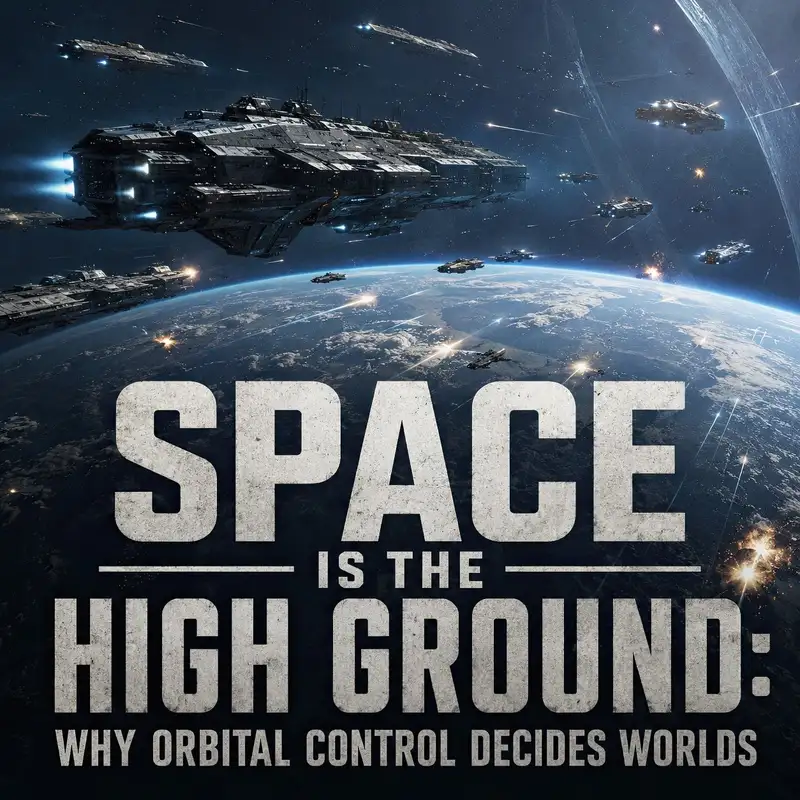
Space Is the High Ground: Why Orbital Control Decides Worlds
The orbital defense platforms above Reach could destroy Covenant warships, but only while the fusion generators below remained in human hands. When enemy forces broke through toward those power complexes, the crisis in orbit became a ground battle. Crews above the planet might still detect and track hostile ships, yet a platform without power could no longer shape the engagement. The decisive action was taking place far beneath the guns, where soldiers were fighting to keep the high ground alive.
That relationship explains why space is the high ground in Halo, but it also explains why the phrase is easily misunderstood. Orbital control is not simply owning the empty distance above a planet. It is the ability to decide who may approach, who may land, who may leave, who receives supplies, and who can place heavy fire on targets below. A fleet in control of local space governs the doors to the world. It may not control every city, valley, tunnel, or population center, but it determines which armies can be sustained and which armies are slowly being cut off.
The word control also needs discipline. A navy rarely owns every kilometer around a planet with equal confidence. It may dominate the slipspace arrival lanes while remaining vulnerable near a moon. It may control high orbit but lack the craft needed to patrol the atmosphere. It may protect one evacuation corridor while losing another. It may drive off the enemy fleet for six hours, long enough to land a division or launch a convoy, without establishing permanent superiority. In campaign terms, orbital control is often temporary, local, and tied to a specific mission.
That temporary control can still decide the world because every planetary operation begins with access. An attacker must emerge from slipspace, orient its force, build a sensor picture, defeat or evade the defending fleet, suppress fixed defenses, and then move troops through the atmosphere. A defender must detect the approach, distribute targeting data, protect its orbital weapons, screen civilian traffic, and preserve enough ships to contest the next arrival. The battle on the surface may attract the eye, but the battle in space determines how much force can reach that surface and how long it can remain there.
In practical terms, the fleet is not merely artillery floating overhead. It is also the port, the airfield, the communications relay, the medical evacuation system, the reserve, and the road back home. A capital ship can launch fighters and dropships, coordinate sensors, carry ammunition, recover wounded personnel, and move an entire formation to another hemisphere faster than a ground commander can move a battalion across difficult terrain. Destroy that ship, and the loss is larger than its weapons. An entire network of movement, information, and support disappears with it.
The Human-Covenant War made this brutally clear. Covenant warships generally possessed better shielding, more destructive energy weapons, and more capable slipspace systems than their human opponents. The United Nations Space Command could still win engagements through concentration, surprise, artificial intelligence, nuclear weapons, and commanders willing to accept terrible losses. Yet those victories were difficult to repeat. A human fleet might save a colony for the day and emerge too damaged to defend the next one. The Covenant could often replace pressure faster than humanity could replace ships.
Harvest provided the first strategic warning. A large human battle group destroyed a single Covenant warship, but the cost exposed the scale of the technological imbalance. The victory did not settle control of the system, and it certainly did not restore ordinary life to the colony. Further fighting continued because one successful engagement did not remove the enemy’s ability to return. The lesson was not that human courage had overcome superior technology. The lesson was that even a victory in space could consume the force needed to exploit it.
Orbital defenses were humanity’s attempt to change that exchange. A planet could not depend on mobile fleets alone, especially when slipspace travel made warning unreliable and reinforcements uncertain. Fixed platforms could mount magnetic accelerator weapons far larger than those carried by many ships. They did not need to spend mass on interstellar drives, accommodations for long deployments, or the fuel required to maneuver across a campaign. Properly supported, they turned the space around a fortified world into a prepared engagement area.
Reach possessed twenty orbital defense platforms, each tied to fusion generators on the surface. Their magnetic accelerator cannons could destroy Covenant ships that might otherwise survive the fire of several human warships. On paper, this made Reach one of the hardest targets in human space. In reality, the network was a combined system. The platforms depended on ground power, targeting information, communications, and defenders below. The Covenant did not have to win a clean gunnery duel against every platform. It could attack the machinery that allowed the platforms to fire.
That is why the defense of the generators was not a secondary ground mission. It was the center of the orbital battle. Army personnel, Marines, and Spartans fighting around those facilities were defending ships they could barely see. Every minute a generator remained operational gave the orbital guns another chance to kill a Covenant vessel. Every perimeter that collapsed removed firepower from the space battle. Reach demonstrates the central paradox of orbital warfare. The high ground may dominate the surface, but it can still depend on vulnerable systems buried in that surface.
Once those systems failed, the character of the campaign changed. Covenant vessels gained freedom to move, land additional forces, isolate human formations, and begin wider bombardment. Ground units could continue to resist. They could protect civilians, destroy sensitive equipment, delay enemy advances, and preserve escape routes. What they could no longer do was restore the strategic situation by winning one more firefight. Without friendly control above them, every ammunition expenditure and every damaged vehicle became harder to replace.
This does not mean the Covenant always attacked a planet simply to glass it from the first moment. Covenant objectives varied. Commanders searched for Forerunner relics, intelligence, prisoners, navigation data, and politically valuable trophies. Religious requirements could make a site too important to destroy. Rival ministries and commanders might pursue different goals on the same world. Ground forces were necessary when the enemy wanted to seize, inspect, excavate, or occupy something. Orbital dominance created options. It did not choose among them.
Glassing itself should be understood as an operation rather than a theatrical button. Ships had to be positioned. Targets had to be selected. Energy projectors had to remain on station. Friendly forces, artifacts, and desired infrastructure could constrain the attack. The destruction might be extensive without being perfectly uniform, and survivors could remain in areas the fleet had not yet struck. Orbital bombardment was devastating because it allowed the attacker to dismantle a world’s military, industrial, and ecological systems from a position most ground forces could not reach. It was not effortless, instantaneous, or identical in every campaign.
Earth showed the other side of the equation. Its orbital defense grid made a direct assault extraordinarily dangerous, and the force led by the Prophet of Regret arrived without understanding the scale of the target it had found. The Covenant penetrated the grid and placed an assault carrier over Mombasa, but that penetration did not equal control of Earth. It created a breach. Through that breach came troops, dropships, armor, and excavation forces. The battle then moved into streets, highways, industrial zones, and the buried Forerunner structure that had drawn Regret there.
The fighting around Mombasa is a useful correction to simplistic ideas about the high ground. A carrier over a city can deliver forces and threaten destruction, but it cannot search every building, interpret every piece of intelligence, secure every tunnel, or compel every civilian to cooperate. Urban terrain breaks sensor lines and creates cover. Local defenders know routes the attacker does not. Ground units still have to seize intersections, protect engineers, clear landing zones, and hold objectives. Orbit can place an army in the city. It cannot perform the army’s work for it.
Regret’s withdrawal made the same point from another direction. When his assault carrier entered slipspace from within the city, many Covenant troops were left behind. Their commander’s mobility did not automatically become their mobility. A force on the ground depends on available transports, functioning communications, and an extraction plan that survives contact with events. The ship possessed the power to leave. The infantry below possessed only the routes and vehicles still available to them. Strategic mobility is not distributed evenly merely because a fleet is overhead.
Logistics is the least glamorous expression of orbital control and perhaps the most decisive. A Marine battalion consumes ammunition, medical supplies, food, water, power cells, vehicle parts, and replacement personnel. An armored formation requires fuel or energy, recovery equipment, maintenance crews, and transport capable of bringing heavy vehicles through the atmosphere. Aerospace craft need servicing and munitions. Spartans require specialized armor support and intelligence. If the enemy controls space, these needs do not vanish. The means of meeting them do.
The same is true for evacuation. A colony may have millions of residents and only a fraction of the lift required to remove them. Civilian ships must be loaded, cleared, organized, and protected through vulnerable departure lanes. Spaceports become military objectives because they are the connection between the population and orbit. Traffic control becomes a life-or-death function. A fleet that protects an evacuation corridor for one hour may save more people than a force that holds an isolated district for a day, although the district may have to be held to keep the corridor open.
Once orbital control is lost, evacuation becomes triage. Every transport represents seats, life support, fuel, and a departure window. Military commanders must decide whether escorts protect civilians, strategic personnel, industrial specialists, military units, or irreplaceable data. Civilian authorities must decide who reaches the loading areas first. Ground forces may be ordered to defend a launch site they will never use. Official histories often record the number of ships that escaped. The people left outside the perimeter remember the same event rather differently.
Control of space also shapes intelligence. Orbital sensors can observe launches, major troop movements, energy emissions, and changes in defensive systems. Ships and platforms can relay communications over enormous areas and connect forces that would otherwise fight as isolated commands. Artificial intelligences can combine these inputs and produce targeting solutions faster than human staffs. Yet orbit is not omniscient. Weather, terrain, camouflage, underground facilities, electronic warfare, damaged sensors, and deliberate deception can hide what matters most.
This is why reconnaissance on the surface remains essential. A fleet may know that an enemy formation entered a region without knowing which tunnel, facility, or artifact it is using. It may detect power consumption without understanding the system being powered. It may have a perfect image of a landing zone that is already compromised by infiltrators. Orbital awareness provides scale and speed. Ground intelligence provides texture. A campaign fails when commanders confuse the first with the second.
Orbital control also creates operational maneuver. A fleet can threaten several continents, shift landing forces, or hold a reserve outside the range of most surface weapons. The defender must either spread forces across many possible objectives or accept that some areas will be uncovered. This is one reason a smaller force with secure access to orbit can create effects far beyond its numbers. It does not have to be stronger everywhere. It has to concentrate faster at the place that matters.
Yet the phrase “space decides worlds” should never be translated into “space conquers worlds.” Conquest requires a political purpose and a force capable of carrying it out. A government that intends to rule a population must control transportation, food, communications, police functions, and local institutions. It must identify allies and opponents. It must prevent sabotage and manage resistance. A fleet can destroy a capital in minutes and still fail to create a government that lasts. Firepower can remove choices from the defender without producing legitimacy for the attacker.
The Covenant often avoided that problem because its war against humanity was exterminatory. It did not need to create durable human consent. Even then, it still required ground operations whenever it wanted information, artifacts, or access to protected sites. The Banished face a different problem. They frequently seek resources, salvage, labor, territory, and Forerunner technology. Those goals require occupation infrastructure. A destroyed world offers fewer things to exploit, which is one reason Banished forces may dominate from orbit while still investing heavily in bases, foundries, prisons, and patrols below.
The ambush of the United Nations Space Command Infinity at Zeta Halo shows orbital control in its most operationally complete form. The Banished struck the flagship as it arrived, compromised its ability to fight as a coordinated force, and drove surviving personnel into evacuation craft. Once the Infinity was gone from the battle, the survivors on the ring lost more than a ship. They lost centralized command, heavy maintenance, secure medical facilities, strategic communications, aircraft support, reserves, and the largest concentration of supplies available to them.
The Banished victory in space allowed them to occupy key areas of Zeta Halo and hunt isolated human groups. For six months, survivors fought without a friendly fleet returning to reopen the system. Every casualty was harder to replace. Every damaged weapon or vehicle reduced future capability. Every radio transmission risked revealing a position. A scattered force could still ambush patrols, rescue prisoners, sabotage installations, and build temporary strongpoints. It could not recreate the support structure that had disappeared with the Infinity.
Even there, orbital success did not equal complete control. Zeta Halo was shattered and displaced. Forerunner systems continued to operate according to priorities neither side fully understood. Sentinels could interfere with both occupier and resistance. The ring’s terrain, internal machinery, and surviving installations created opportunities for concealment and counterattack. The Banished held the advantage because they controlled organized movement and supply, not because every meter of the installation had become obedient to them.
Spartans are especially useful for understanding the difference. A Spartan can destroy an orbital gun, board a ship, seize a landing zone, or sabotage a generator. Those actions may alter control of space far beyond the size of the team involved. A Spartan can therefore help create or deny the high ground. A Spartan cannot replace the fleet that uses it. Without transport, ammunition, intelligence, maintenance, and extraction, even the most capable operator becomes a local asset with a shrinking set of options.
This is why battles for orbit are often fought through denial rather than permanent possession. A defending fleet may not be able to destroy the enemy, but it may disrupt formation, force ships away from an evacuation lane, or delay bombardment. Fighters may screen transports. A ground team may disable a sensor array. An orbital platform may compel a carrier to maneuver instead of launching dropships. Success may mean opening a corridor for twenty minutes. In a campaign measured by who escapes and what survives, twenty minutes can be strategic.
The industrial dimension makes orbital control even more important. Worlds do not merely host populations. They contain shipyards, training centers, depots, reactors, factories, and communications nodes. A fleet that controls orbit can isolate those systems and destroy them in sequence. The loss then reaches beyond the current battle. Ships awaiting repair remain damaged. Crews lack replacements. Ammunition production falls. Training pipelines break. A colony may still contain surviving soldiers while no longer functioning as part of the war economy.
Reach mattered for precisely this reason. Its value was not limited to the forces present on the day of invasion. It was a naval and industrial center that helped humanity generate future military power. Losing orbit exposed the infrastructure that sustained fleets across human space. The Covenant therefore won more than a position on a map. It removed capacity from every later campaign. The defenders who fought for the orbital generators were defending the present battle, but they were also defending ships that had not yet been repaired and crews that had not yet deployed.
Orbital power also carries political weight. The fleet above a world can enforce a blockade, threaten bombardment, support one government, or isolate another. Those effects may compel surrender without a full invasion. They may also produce resistance, refugee flows, economic collapse, and hatred that survives the ships themselves. A government can mistake the ability to punish a population for the ability to govern it. Halo repeatedly shows advanced powers making that error, usually because a clean tactical display looks more persuasive from orbit than it feels on the ground.
To judge a planetary campaign, begin with the gates rather than the battlefield. Ask who controls the slipspace approaches, who can maintain ships in orbit, who can protect transports, and who can replace losses. Then ask what that control is meant to accomplish. A fleet seeking extermination uses the high ground differently from a fleet protecting an evacuation. A force hunting an artifact accepts different risks from one defending an industrial base. The same orbital position can support rescue, occupation, coercion, or destruction.
Reach, Earth, and Zeta Halo each reveal a different part of the answer. At Reach, ground forces fought to keep orbital weapons firing, and the collapse below helped decide the battle above. At Earth, a breach in the defense grid allowed an invasion of one region without producing immediate control of the planet. At Zeta Halo, the destruction of organized human power in space transformed every surviving ground unit into an isolated force living on what it could carry, recover, or steal.
Space is the high ground because it governs access, movement, supply, intelligence, evacuation, and the heaviest forms of fire. It decides which armies can arrive and which armies can endure. It does not remove terrain, civilians, politics, or resistance. It does not convert bombardment into government, or a landing into occupation. The final verdict on a world is written where orbit and surface meet: at the generator feeding the gun, the spaceport loading the last transport, and the ground position holding long enough for someone else to leave.