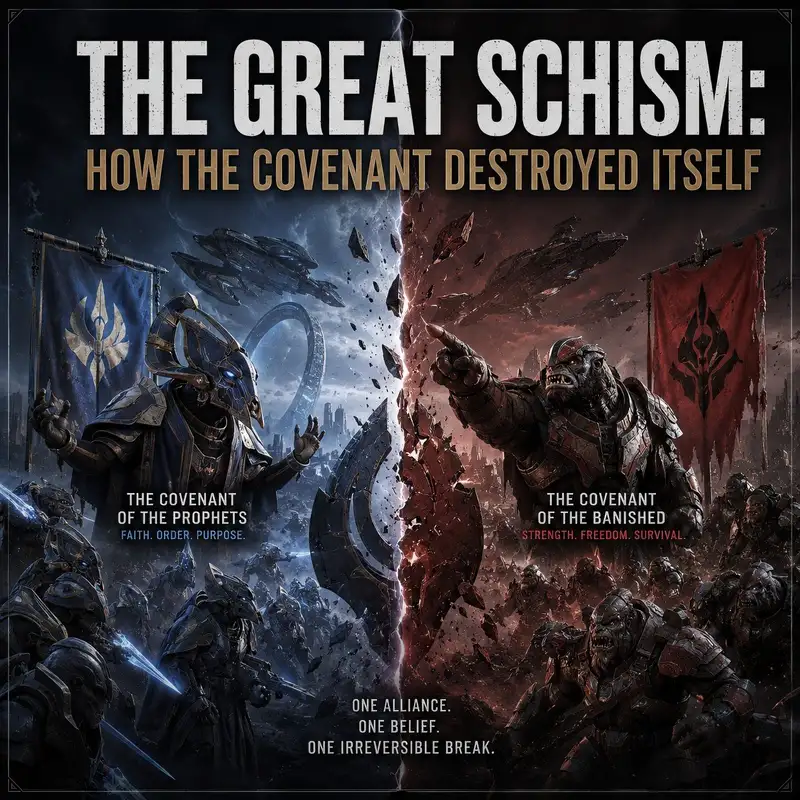
The Great Schism: How the Covenant Destroyed Itself
The order that opened the Great Schism was disguised as a summons. On November third, twenty-five fifty-two, Sangheili councilors on Delta Halo were called toward the ring’s control center under the pretense that Covenant leadership would address the death of the Prophet of Regret and select his successor. Jiralhanae escorts met them on the route. The weapons those escorts carried were already marked with Sangheili blood. Within moments, warriors who had served the same empire were firing on one another, and the councilors were being dragged into prison cells or killed. The Covenant’s civil war did not begin with a public declaration. It began with a purge.
The sudden violence can make the Great Schism look like an eruption of species hatred that finally escaped control. Hatred was present, but it was not the complete cause. The Schism was a political coup planned by the Prophet of Truth, carried out through a transfer of military authority from the Sangheili to the Jiralhanae, and accelerated by a religious crisis the Covenant could no longer contain. The empire destroyed itself because its leaders tried to preserve their authority by attacking the military caste that had enforced that authority for thousands of years.
The Covenant had been built on a bargain between the San’Shyuum and the Sangheili. The Writ of Union ended their ancient war by assigning different forms of power to each side. San’Shyuum leaders interpreted Forerunner relics, controlled religious doctrine, and directed imperial policy. Sangheili commanders supplied fleets, armies, and the martial legitimacy needed to conquer or absorb other species. The arrangement was unequal, but mutually dependent. The Prophets could issue sacred orders because Sangheili warships and soldiers made those orders real.
That division also created the Covenant’s most dangerous internal fault line. The San’Shyuum controlled the meaning of the Great Journey, yet the Sangheili controlled much of the force that protected the Hierarchs, commanded the fleets, and punished heresy. Sangheili councilors sat within the High Council and expected their species’ military status to remain protected by the founding agreement. The system worked while religious authority and military honor pointed in the same direction. It became unstable the moment the Prophets feared the officers required to enforce their rule.
The incorporation of the Jiralhanae gave the Hierarchs a potential counterweight. Their species entered the Covenant late in the empire’s history after surviving a devastating civil conflict on Doisac. The Covenant valued their physical power, pack organization, and willingness to conduct difficult assaults. Sangheili leaders frequently treated them as a subordinate and culturally inferior force. Jiralhanae warriors saw themselves sent into costly attacks while Sangheili officers claimed rank and recognition. The grievance was real, even when Jiralhanae commanders expressed it through brutality of their own.
Competition followed because both species occupied military roles and neither accepted the other’s claim to leadership. The Sangheili believed centuries of service and the Writ of Union gave them rightful command. The Jiralhanae saw an entrenched caste protecting its privileges while denying advancement to warriors doing much of the dying. Promotions, weapons, ship assignments, and access to the Prophets became political signals. Truth did not create this rivalry. He recognized that it could be converted into an armed constituency dependent on him.
The three Hierarchs who began the war against humanity had already founded their rule on concealed evidence. Truth, Regret, and Mercy learned that humans possessed a relationship with Forerunner systems that threatened Covenant doctrine. Rather than permit the discovery to weaken the Great Journey or their own rise to power, they declared humanity an enemy to be exterminated. That decision made secrecy a requirement of government. Any Sangheili commander who investigated too deeply, questioned why humans could not be converted, or learned what Halo actually did could become a threat to the entire political order.
The heretic movement led by Sesa ‘Refumee demonstrated the danger. On a gas mine near the remains of Installation Zero Four, Sesa learned from the monitor Three Four Three Guilty Spark that the sacred rings were weapons rather than instruments of transcendence. The Prophets sent the newly appointed Arbiter, Thel ‘Vadamee, to destroy the movement before the information spread. He succeeded. The mission preserved religious control, but it also warned Truth that Sangheili soldiers could become dangerous once evidence reached them. The problem was no longer whether doubt existed. It was whether the people commanding the fleets would begin sharing it.
Truth increasingly favored Jiralhanae leaders such as Tartarus and elevated their access to authority. The transfer was not announced as a plan to eliminate the Sangheili. It appeared through promotions, special assignments, new equipment, and private orders. That method preserved deniability while allowing Truth to build a force personally tied to his patronage. It also ensured that many Jiralhanae interpreted their elevation as overdue recognition rather than preparation for civil war.
The earliest killings began before Regret died. When the Prophet’s carrier departed New Mombasa for Delta Halo, Sangheili troops were left behind on Earth. Jiralhanae commanders received secret orders to eliminate them. Human personnel moving through the occupied city later found evidence that Covenant troops had been killing one another while the wider empire remained unaware. This was not yet the open Great Schism, but it proves that the purge was already in motion. Regret’s death provided the public justification for a plan that had begun in private.
Regret was killed on Delta Halo by John One One Seven. Truth ordered the temple attacked in an effort to kill the Spartan, even though the bombardment also destroyed a sacred site and any chance of recovering the Hierarch alive. The official response blamed the Sangheili honor guard for failing to protect Regret. Truth then transferred the role of protecting the Prophets to the Jiralhanae. The announcement was presented as a necessary correction after a security failure. Politically, it removed Sangheili warriors from immediate access to the surviving Hierarchs and placed Truth’s favored troops at the center of government.
The Changing of the Guard was therefore much larger than a ceremonial exchange of armor. Honor guards controlled access, security, and the physical space around Covenant leadership. Removing the Sangheili told every commander that the Writ of Union no longer guaranteed the position of their species. Sangheili councilors protested and threatened to withdraw from the Covenant. Truth responded as though the change were administrative. An empire built on ritual was expected to believe that replacing one founding people with a recently incorporated rival was merely an exchange of uniforms. The councilors were not persuaded.
Regret’s death should also have opened a succession process. Covenant government depended on three Hierarchs, and Sangheili councilors expected a voice in selecting the replacement. Truth instead used the emergency to bypass the political mechanism that might have restored balance. The councilors summoned to Delta Halo were not being gathered to deliberate freely. They were being placed where loyal forces could control them. A security failure had become a constitutional rupture, although Covenant political language had no comfortable phrase for a coup conducted in the name of divine continuity.
Truth could not stop at demotion. Sangheili officers still commanded fleets, ships, garrisons, and warrior households across Covenant space. If they remained organized, they could challenge his decision or remove him. The coup therefore required simultaneous action against political leaders and military commands. Councilors were summoned, isolated, imprisoned, or killed. Sangheili shipmasters were replaced where Jiralhanae forces could seize control. Units received different explanations depending on what would secure obedience. Compartmentalization made the opening blow possible. It also guaranteed confusion once the shooting began.
Tartarus’s betrayal of the Arbiter exposed the plan at the decisive moment. Thel had retrieved the Activation Index from the Flood-infested Library on Delta Halo, completing the mission assigned by the Prophets. Tartarus took the Index and attempted to kill him on Truth’s orders. The Arbiter had served as the Covenant’s sanctioned weapon against heresy, survived missions intended to consume him, and delivered the object required to begin the Great Journey. None of that protected him once his usefulness ended. Truth discarded the soldier most publicly associated with obedience because the Sangheili office he carried had become politically dangerous.
For ordinary Covenant troops, the first hours were defined by incomplete information. Sangheili warriors saw Jiralhanae killing councilors and former comrades. Jiralhanae units were told they were suppressing treason and assuming authority denied to them for generations. Unggoy, Kig-Yar, Lekgolo, Yanme’e, and Huragok did not all choose one side as species-wide blocs. Local loyalties, commanders, faith, coercion, survival, and access to transport shaped their decisions. Mixed crews and garrisons could divide compartment by compartment. The Covenant had organized diversity through hierarchy. Once the hierarchy split, every relationship inside it became a possible front line.
Jiralhanae support was not perfectly uniform. Some veterans understood that the Prophets had spent their packs as readily as Sangheili commanders had and suspected that promised transcendence might be another instrument of control. Avitus, the commander known as Thrallslayer, could question the Great Journey while still carrying out the purge because he believed the transfer of power would finally repay generations of Jiralhanae sacrifice. Truth did not require every follower to share one belief. He needed faith, resentment, ambition, and obedience to point toward the same target for long enough.
High Charity turned that institutional failure into military collapse. The mobile capital was simultaneously the empire’s religious center, political headquarters, industrial hub, communications node, and home to an enormous civilian population. Fighting erupted in its chambers while Sangheili and Jiralhanae ships exchanged fire outside. Security forces that should have defended the city were trying to seize it from one another. Fleet commanders had to decide whether orders from the Hierarchs remained lawful, whether neighboring vessels were hostile, and whether their own crews would obey. The Covenant still possessed superior warships. It no longer possessed one command structure capable of using them together.
News spread unevenly through ships, garrisons, and distant Covenant territories. Some Sangheili learned of the councilor massacres through recordings and immediately turned their weapons on Jiralhanae commanders. Others first received orders accusing their own species of rebellion. Fleets that had been organized around one chain of authority began sorting themselves by captain, crew, and local balance of force. A ship could remain operational while its escort chose the opposite side. A garrison could hold its fortress and lose every transport needed to leave it. The Schism became interstellar because the Covenant had distributed its rivalries everywhere it had distributed military power.
Truth’s choice also created an immediate competence problem. Sangheili commanders had led Covenant fleets for thousands of years. Their experience included navigation, formation, logistics, relic operations, and coordination among species with very different capabilities. Jiralhanae leaders were not inherently incapable, and several proved disciplined and effective. They had not been given time to replace an entire imperial officer corps while simultaneously fighting that officer corps. Political loyalty can accelerate promotion. It cannot instantly create the shared procedures required to direct a fleet whose crews are uncertain which species now owns the bridge.
The Covenant’s industrial system began fragmenting at the same time. High Charity contained assembly forges, ministries, archives, technical specialists, and access to the Forerunner Dreadnought powering much of the city. Fleets elsewhere depended on tithe routes, maintenance networks, and political authorization centered on the capital. A shipmaster could retain a functioning cruiser after the Schism and still lose access to replacement components, navigation support, or the ministry that had assigned the vessel’s mission. The empire’s weapons survived the government. Their support structure did not survive intact with them.
Then the Flood arrived. The parasite seized the human frigate In Amber Clad and used it to enter High Charity while the capital’s defenders were killing one another. The timing could hardly have favored the Flood more. Population, ships, technical knowledge, and damaged security systems were concentrated in one place. Infection spread through a city whose emergency response had already become a civil war. The Flood did not cause the Great Schism, but it converted a political coup into the physical destruction of the Covenant’s center.
Mercy was infected during the collapse. Truth abandoned him and departed aboard the Forerunner Dreadnought, taking the keyship and the authority of the last functioning Hierarch toward Earth. The triumvirate was gone. Regret was dead, Mercy was left behind, and Truth no longer had a High Council capable of legitimizing succession or policy. He retained loyal Jiralhanae forces and the religious claim that the Great Journey was close. He did not retain the institutional Covenant that had existed before the purge.
The Arbiter survived because the Gravemind recovered him. That intervention did not make the Flood an ally. It placed Thel where he could help prevent the ring from firing. He later heard the monitor explain Halo’s actual function and confronted evidence Sesa ‘Refumee had died trying to spread. The discovery did not instantly unify every Sangheili or erase generations of belief. It gave one local coalition a new reason to resist Truth beyond revenge. The Prophets had betrayed the Sangheili politically and lied about the weapon they intended everyone to activate.
Tartarus rejected the evidence and attempted to fire Delta Halo using Commander Miranda Keyes as the required human Reclaimer. His choice was shaped by faith, ambition, loyalty to Truth, and the position the new order had given him. The Arbiter joined human forces led by Keyes and Avery Johnson to stop the activation. When Tartarus fell, the Jiralhanae lost their principal commander in that theater. More importantly, a Sangheili leader and human personnel had fought for the same operational objective: preventing a weapon from killing both species.
That cooperation became the foundation of the Fleet of Retribution under Shipmaster Rtas ‘Vadum. It was not a treaty between all humanity and all Sangheili. It was an alliance of forces facing Truth, the Flood, and the Halo Array. Human officers remembered the worlds Sangheili fleets had destroyed. Sangheili officers remembered decades of fighting humans they had been taught were heretics. Neither side required forgiveness before coordinating sensors, ships, landing forces, and targets. Extinction pressure has a way of shortening the diplomatic agenda.
For humanity, the Schism arrived at the point when conventional survival was becoming doubtful. Reach had fallen. Earth was under attack. Human fleets had been depleted across nearly twenty-eight years of war. The United Nations Space Command had won battles and lost the ships needed for the next defense. It did not defeat the intact Covenant through superior industry or fleet strength. The Great Schism divided the enemy’s war machine, redirected Covenant ships against one another, and produced an allied Sangheili force with technology and intelligence humanity could not supply for itself.
Truth still possessed enough power to threaten every surviving civilization. He reached Earth, activated the portal near Voi, and traveled to the Ark, where the entire Halo Array could be fired remotely. Loyalist Jiralhanae, remaining Covenant forces, and automated Forerunner defenses protected his position. The surviving human and Sangheili coalition followed. At Voi, Rtas ‘Vadum’s ships used energy projectors against Flood-contaminated territory, a severe containment measure accepted because an infected vessel had reached Earth. The alliance was already making decisions that neither side would have trusted the other to make weeks earlier.
On the Ark, Truth attempted to complete the Great Journey while the organization founded to pursue it no longer existed as a coherent empire. Human and Sangheili forces broke through his defenses. The Arbiter killed Truth before the Array could be activated. By December twelfth, twenty-five fifty-two, the last Hierarch’s death and the failure of the firing sequence ended the Covenant as a functioning central state. The Human-Covenant War ended because the enemy government collapsed, not because every loyalist ship, soldier, or believer surrendered.
The Great Schism did not end every conflict it created. Sangheili commanders formed competing coalitions. Jiralhanae packs fought for ships, food, territory, and leadership. Some former Covenant species followed local alliances or withdrew from the old war. San’Shyuum survivors hid or pursued their own plans. Religious revivalists and regional warlords later adopted the Covenant name without recreating its institutions. The Swords of Sanghelios sought unity under the Arbiter, while other keeps rejected his authority. The civil war destroyed one empire and created many smaller wars over its inheritance.
Truth’s coup failed because it confused personal control with state power. He believed the Jiralhanae could replace the Sangheili because they would owe their elevation to him. He underestimated how much Covenant military effectiveness depended on Sangheili command, how quickly the founding bargain would become a species-wide survival issue, and how dangerous it was to begin a purge during a Halo crisis and a Flood outbreak. He gained a more obedient guard and lost the alliance that made obedience consequential across the empire.
The Covenant destroyed itself because its unity rested on controlled interpretation. The Prophets defined what the Forerunners meant. The Sangheili enforced that meaning. The Jiralhanae were promised advancement within it. Subject species were assigned places beneath it. Once Truth tried to preserve the doctrine by replacing its principal military guardians, every hidden contradiction became an armed dispute. Religious truth, political authority, species status, fleet command, and personal survival all changed sides at once.
Above High Charity, Covenant warships remained shielded, armed, and crewed when they began firing on one another. The technology had not failed. The empire’s founding agreement had. Humanity survived because the Covenant reached the moment when serving its leaders required destroying the people, fleets, and institutions that had kept those leaders in power. The Great Schism was not an external defeat imposed on a superior enemy. It was the Covenant’s military strength turned inward by a government that chose a purge over the truth.