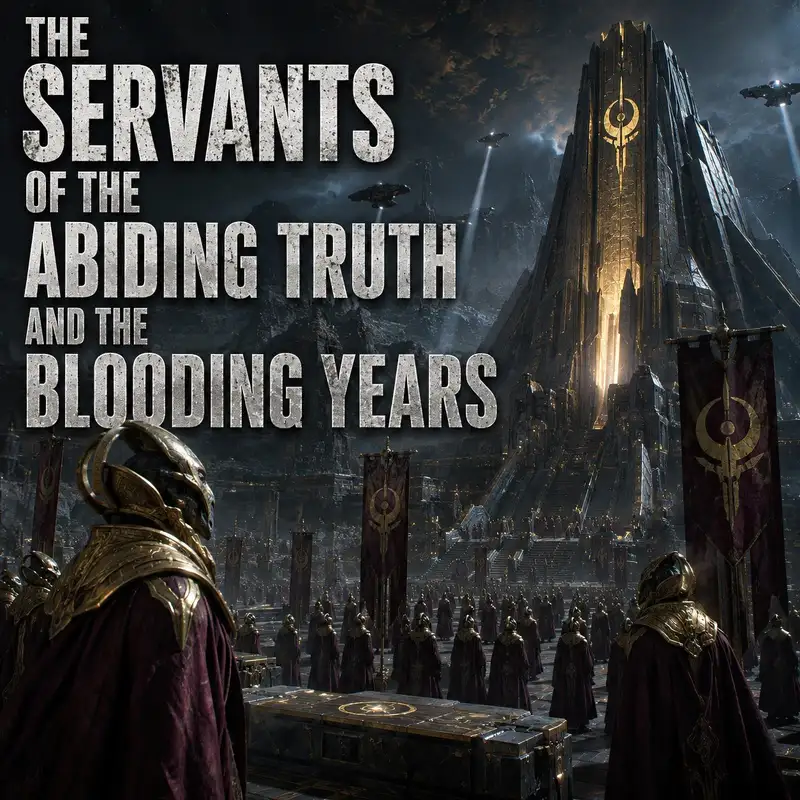
The Servants of the Abiding Truth and the Blooding Years
Vadam Keep was already under attack when the political situation shifted faster than the battle line. Avu Med ‘Telcam had brought nine ships and warriors from allied keeps against the Arbiter’s home territory. Thel ‘Vadam’s reinforcements were late, the attackers were moving inland, and ‘Telcam’s damaged flagship had crashed onto the coast without ending the assault. Then word spread that humans had landed on Sanghelios. Neutral keeps began sending troops to the rebels. The Arbiter’s alliance with humanity had become the most effective recruiting message his enemies possessed.
The Blooding Years began within months of the Covenant’s collapse, but they were not one war between two clearly organized governments. They were overlapping civil conflicts among keeps, religious movements, fleet commanders, Jiralhanae survivors, local separatists, Covenant loyalists, and outside powers attempting to shape the result. The Servants of the Abiding Truth became one of the most important early factions because they gave that disorder a language of legitimacy. They argued that the Prophets had lied, but that the old gods remained divine, and that Thel ‘Vadam had answered betrayal with blasphemy.
The central question is why an ancient monastic order could become a serious military threat so quickly. The answer lies in the way the Covenant had collapsed. Sangheili society retained ships, weapons, keeps, warrior lineages, and religious traditions, but lost the imperial institutions that had connected them. There was no accepted central government capable of disarming private fleets or settling every dispute. The Arbiter had allies, not universal authority. In that environment, a religious order with hidden relics, a respected commander, foreign weapons, and access to dissatisfied keeps could become an insurgent army before anyone agreed on what the new law was.
The Servants of the Abiding Truth had existed since the Covenant’s founding in eight hundred fifty-two B C E. Their earliest members hid Forerunner artifacts from the San’Shyuum, preserving a pre-Covenant Sangheili tradition of worship outside Prophet control. The order survived for more than three thousand years because it was never simply another ministry of the empire. It existed beneath the official religious structure, guarding objects and practices its members believed the Prophets had corrupted. The Covenant’s destruction did not create the Servants. It removed the political ceiling that had kept an old religious current from becoming an open military movement.
Their theology made them more complicated than conventional Covenant loyalists. The Servants accepted that the High Prophets had betrayed the Sangheili and that the promised Great Journey had been manipulated. They did not accept Thel’s wider conclusion that the Forerunners were fallible beings rather than gods. To them, a false priesthood did not make the divine false. The Arbiter’s willingness to describe Halo as a weapon, cooperate with humans, and permit Forerunner objects to be studied without reverence appeared to replace one heresy with another. They wanted purification, not restoration of San’Shyuum rule.
The Temple of the Abiding Truth in Ontom gave doctrine a physical headquarters. It was a Forerunner structure containing symbols that the Servants believed might point toward the Halo Array. After the war, its halls also became a weapons cache, command post, meeting place, and intelligence target. Warriors moved firearms and equipment through a sanctuary built around the technology they worshiped. The transformation was revealing. The order did not stop being religious when it became militant. It treated military preparation as the defense of religion, which made the temple a monastery with a motor pool and considerably less room for theological disagreement.
Avu Med ‘Telcam supplied the leadership required to turn belief into operations. He had served as a Covenant Field Master and interpreter of several human languages before leaving military service. Human intelligence officers called him the Bishop. The name captured his religious role but understated his experience. ‘Telcam understood command, logistics, concealment, and the use of political grievance. He was patient enough to negotiate with humans he despised and committed enough to refuse fire on Forerunner structures even when that restriction made his own battle plan more difficult.
His appeal extended beyond strict believers. Some Sangheili joined because they feared that Thel’s alliance with humanity would make their species dependent on its former enemy. Others opposed reforms that threatened established keep authority or warrior privilege. Rival kaidons saw a chance to weaken Vadam. Veterans who had lost status after the Covenant’s fall wanted a new command. Several allied keeps did not necessarily share every part of the Servants’ theology. They shared an enemy. Religious certainty provided the banner, while local ambition, wounded pride, and uncertainty supplied much of the manpower.
The military environment favored that coalition. Covenant fleets had fragmented among surviving shipmasters and political patrons. Vehicles, weapons, and aircraft were scattered through keeps, abandoned depots, and partially functioning shipyards. The Servants stockpiled arms and stole equipment, but they did not possess the industrial system required to replace every loss. Their force was therefore strongest as an insurgency supported by local allies. It could raid, assassinate, intimidate, and concentrate briefly for an attack. Sustaining a long conventional campaign against the Swords of Sanghelios was a much more difficult proposition.
The Office of Naval Intelligence saw opportunity in that weakness. Admiral Margaret Parangosky believed a divided Sangheili population would be less capable of threatening a humanity still recovering from near extinction. The strategy differed sharply from Admiral Terrence Hood’s effort to build a durable alliance with the Arbiter. One part of the human military wanted Thel stable enough to keep the peace. Another wanted him weak enough that the peace could not become a future strategic danger. Both policies operated at the same time, which was efficient only if the objective was confusion.
In January twenty-five fifty-three, Captain Serin Osman and cultural specialist Evan Phillips met ‘Telcam on the glassed human colony of New Llanelli. The location offered secrecy and a useful reminder of what Sangheili fleets had done during the war. ‘Telcam agreed to cooperate if humanity stopped denying the divinity of the Forerunners and withdrew from Sangheili affairs after his victory. Osman accepted the terms. The surviving evidence makes clear that the Office of Naval Intelligence did not intend to create an independent and powerful Servants government. It intended to create pressure.
Kilo-Five began delivering human and Covenant weapons to the movement. Some shipments were designed to be traceable so intelligence officers could follow where the arms moved. Others were concealed behind pirate activity and altered records. The prowler Port Stanley and its artificial intelligence, Black-Box, could enter the region without announcing human involvement. The weapons did not need to make ‘Telcam stronger than the Arbiter. They needed to keep both sides spending ships, ammunition, personnel, and political attention that might otherwise be directed toward humanity.
This was proxy warfare in its most recognizable form. The sponsor and the client agreed on the immediate enemy and disagreed about the desired end state. ‘Telcam wanted to overthrow Thel and impose his religious order. The Office of Naval Intelligence wanted neither side to gain enough power to unify Sanghelios. Every successful Servants attack weakened the Arbiter. Every Servants loss reduced a hostile faction. The calculation looked economical from a human briefing room. It looked very different inside Sangheili keeps receiving the weapons and burying the dead.
The Servants demonstrated early that their campaign would not remain a debate among theologians. When Relon decided to demolish a Forerunner monument on his land, the order attacked his keep with a Spirit dropship. Relon and his brother Jalam were killed, their bodies displayed, and a warning was left for anyone considering similar action. The incident was terrorism directed at cultural policy. It communicated that control of relics would be enforced through exemplary violence, and that private landholding ended where the Servants declared sacred ground began.
Jul ‘Mdama initially worked with ‘Telcam from pragmatism rather than devotion. Jul and his associates helped steal the frigate Unflinching Resolve from the Aanrar Shipyard and conceal it in a quarry. Suspicious of ‘Telcam’s secret suppliers, Jul followed him to New Llanelli and discovered the human connection. Naomi Zero One Zero captured him before he could expose it. The Office of Naval Intelligence had armed one anti-Arbiter faction and, through the secrecy surrounding that operation, helped push another future warlord toward his own movement.
The immediate trigger for open war came from a different grievance. In March twenty-five fifty-three, enslaved Jiralhanae in Ontom launched attacks that killed dozens of Sangheili before the city militia suppressed them. ‘Telcam treated the uprising as proof that the post-Covenant order was disintegrating and that delay favored the Arbiter. He called for an immediate assault on Vadam. A revolt rooted in Jiralhanae oppression became the signal for a Sangheili religious civil war. The Blooding Years rarely permitted one conflict to remain separate from another.
‘Telcam gathered nine vessels and forces from Nuan Keep, Rtova Keep, and other supporters. Unflinching Resolve served as his command ship. The operational goal was to break the Arbiter’s power before the Swords of Sanghelios could consolidate. ‘Telcam ordered his shipmasters to avoid damaging Forerunner structures throughout Vadam, even when those restrictions limited attacks on ground positions. His commanders understood the military cost. The order considered the cost acceptable. A campaign fought to defend sacred objects could not begin by destroying them for tactical convenience.
The battle punished that restriction and the rebels’ limited readiness. Unflinching Resolve took a direct hit, and its shipmaster warned that the frigate needed to withdraw. ‘Telcam ordered the attack to continue. The vessel crashed on the coast, but ‘Telcam, Jul’s wife Raia, Forze ‘Mdama, and other survivors escaped the wreck and joined the ground force. The loss removed a command platform without ending the offensive. Sangheili warrior culture expected leaders to remain in the fight. Naval damage control was less impressed by the gesture.
The Arbiter initially appeared capable of containing the attack. Then the presence of humans on Sanghelios became public knowledge. Evan Phillips had been separated from his handlers during the Ontom violence, and Kilo-Five entered the system to recover him. For high kaidons already suspicious of Thel, human troops on the homeworld confirmed their worst interpretation of his policy. Additional keeps joined the Servants. A rescue mission with limited tactical scope changed the political balance of the campaign because the identity of the rescuers mattered more than their numbers.
Thel’s own reinforcements could not arrive in time. He accepted Hood’s offer of direct assistance, knowing that refusal might cost Vadam and acceptance would strengthen the accusation that he ruled through human support. The United Nations Space Command Infinity arrived over Sanghelios, destroyed the rebel destroyer Defender of Faith, and used a magnetic accelerator cannon strike against Servants ground concentrations. The surviving rebels were driven from Vadam. Orbital fire had solved the immediate tactical problem and made the Arbiter’s political problem considerably harder.
At the same time, Port Stanley operated under Kig-Yar cover and attacked several of the Arbiter’s ships. Black-Box impersonated a pirate shipmistress while Kilo-Five attempted to preserve the balance between the factions. Human policy had placed Infinity on Thel’s side and a classified prowler against parts of his fleet during the same battle. The contradiction was not an accident. Hood wanted an allied government to survive. Parangosky wanted every possible Sangheili government to remain constrained. The Arbiter received enough help to win and enough sabotage to ensure the victory remained costly.
The Siege at Kolaar ended with Vadam still in Thel’s hands, but it was not a decisive destruction of the Servants. ‘Telcam escaped to New Llanelli, where the order established a base among the ruins of a human city. Only a few frigates survived the retreat, and several senior supporters died, including Raia and Forze aboard Cleansing Truth. The rebels had failed to remove the Arbiter. They had proven that his position could be threatened quickly, that neutral keeps could be mobilized by anti-human fear, and that his survival might depend on the very alliance his enemies condemned.
The wider civilian cost was difficult to separate from private rivalry. When warriors left anti-Arbiter keeps to join the fighting, neighboring clans sometimes attacked the families and land left behind. At Nes’alun Keep, women and children were forced to defend themselves from a rival seeking territory while the keep’s warriors were away. Jiralhanae servants revolted in other regions. Unggoy laborers, household retainers, artisans, and civilians were caught inside wars officially described through the decisions of kaidons and fleetmasters. The change of banners did not provide them with neutral ground.
After Kolaar, the Servants shifted toward attrition. They launched raids, covert attacks, and efforts to recruit neutral keeps rather than repeating the same vulnerable concentration of ships. New Llanelli offered concealment and distance from Sanghelios. Their limited fleet made every hull important. ‘Telcam offered payment to Kig-Yar intermediaries to recover the stolen battlecruiser Pious Inquisitor, hoping one major warship could restore strategic options. The episode demonstrated the movement’s logistical ceiling. Faith could recruit warriors. It could not manufacture a replacement frigate or compel a privateer to honor the contract.
The Blooding Years expanded across Sangheili space because the Servants were only one participant. Fighting continued between Sangheili and Jiralhanae forces. Jul ‘Mdama assembled a separate Covenant faction. Local warlords pursued old rivalries, and some colonies considered independence from Sanghelios altogether. Worlds such as Malurok and Feldokra experienced conflict, while Qikost became associated with colonial separation and Suban served as a form of neutral refuge. The term described an era of political fragmentation more accurately than one continuous front line.
Jul’s movement and the Servants remained distinct despite their shared hostility toward Thel. During human captivity, Jul learned of plans within the Office of Naval Intelligence to destroy the Sangheili food supply and escaped to Hesduros. He then built a new faction using Covenant identity, Forerunner access, and the promise of restored power. The Servants refused to join him even after suffering heavy losses. ‘Telcam’s order claimed an older Sangheili piety. Jul’s Covenant used the wreckage of imperial religion as a tool of mobilization. The difference mattered to both leaders, even when their troops attacked the same enemy.
The war also divided one family across competing movements. Raia and Forze died during the retreat from Vadam. Believing himself partly responsible, ‘Telcam took Raia’s son Dural as an apprentice. Dural eventually became the Pale Blade and rose into the Servants’ leadership while his father Jul commanded a separate Covenant force. Jul did not initially know what his son had become. The political fragmentation of Sanghelios was therefore not an abstract arrangement of factions. It passed through households already damaged by the war against humanity and then divided again by the peace.
The Servants remained dangerous because they combined several kinds of power without mastering any one of them completely. Their ancient religious identity gave them legitimacy among believers. Keep alliances provided manpower and local access. Captured equipment and foreign weapons supplied combat capability. Scattered ships allowed movement beyond Sanghelios. Their weaknesses were equally clear. They lacked a secure industrial base, unified control over every allied keep, and enough naval power for sustained open battle. The movement survived by remaining harder to eliminate than to defeat in one location.
By twenty-five fifty-eight, the relationship with the Office of Naval Intelligence had reached its predictable conclusion. ‘Telcam had severed ties with the humans who once supplied him, and Serin Osman authorized his removal after he outlived his usefulness. On January twenty-first, a Spartan Three Headhunter designated G Zero Five Nine infiltrated the Servants’ position on New Llanelli. She killed two senior commanders and then killed ‘Telcam in close combat. The organization that had armed the Bishop completed the operation by sending a Spartan to close the account.
The strike was tactically precise and strategically incomplete. Dural was a secondary target, but he was absent. He assumed control and redirected the surviving Servants toward another vulnerable center of power. The faction infiltrated the shield world at the former site of Onyx, where humans, Sangheili, Unggoy, and other residents were attempting to build a shared society under the threat of the Created. The Servants endangered scientists, students, civilians, and security forces while seeking access to Forerunner power. Removing the leader had not removed the belief, the network, or the grievances that supported it.
When the shield world withdrew into slipspace for protection, Dural’s surviving forces fell back to Mackintosh, one of the planets enclosed within it. Official reporting identifies that as the Servants’ last known location. Their continued survival is important because the Blooding Years are often treated as ending in twenty-five fifty-eight, when Jul ‘Mdama’s Covenant was defeated and the Arbiter’s position on Sanghelios became stronger. Later Sangheili accounts were less certain. Thel himself judged that the Blooding Years were barely over, if they had ended at all.
That uncertainty reflects the real outcome. The Swords of Sanghelios won important battles and became the strongest governing alliance on the homeworld. They did not erase old religion, keep rivalry, colonial separatism, Jiralhanae hostility, or distrust of humanity. Human intervention saved Thel at Vadam and gave opponents lasting evidence that his authority depended on outsiders. Office of Naval Intelligence manipulation weakened the Sangheili as intended, but also supplied anti-human movements with weapons, martyrs, and a persuasive account of human duplicity.
The Servants of the Abiding Truth mattered because they were not merely leftovers from the Covenant. They were an older tradition adapting to an imperial collapse. Their leaders rejected the Prophets while preserving the idea that political legitimacy flowed from sacred Forerunner inheritance. They fused that claim with keep politics, military patronage, and foreign support. Their campaign could therefore survive doctrinal exposure, battlefield defeat, and leadership loss. The order did not need the Great Journey to remain dangerous. It needed enough believers to defend the relics and enough weapons to define everyone else as a blasphemer.
The Blooding Years were the price of discovering that liberation and political order are different achievements. The Arbiter attempted to build authority through alliance and reform. The Servants attempted to restore certainty through religious violence. The Office of Naval Intelligence attempted to purchase security through controlled fragmentation. Each gained short-term advantages, and each helped create conditions the others could exploit. The Covenant fell because its central truth was false. The fighting that followed began because too many armed survivors still needed a truth that would tell them who was permitted to rule.