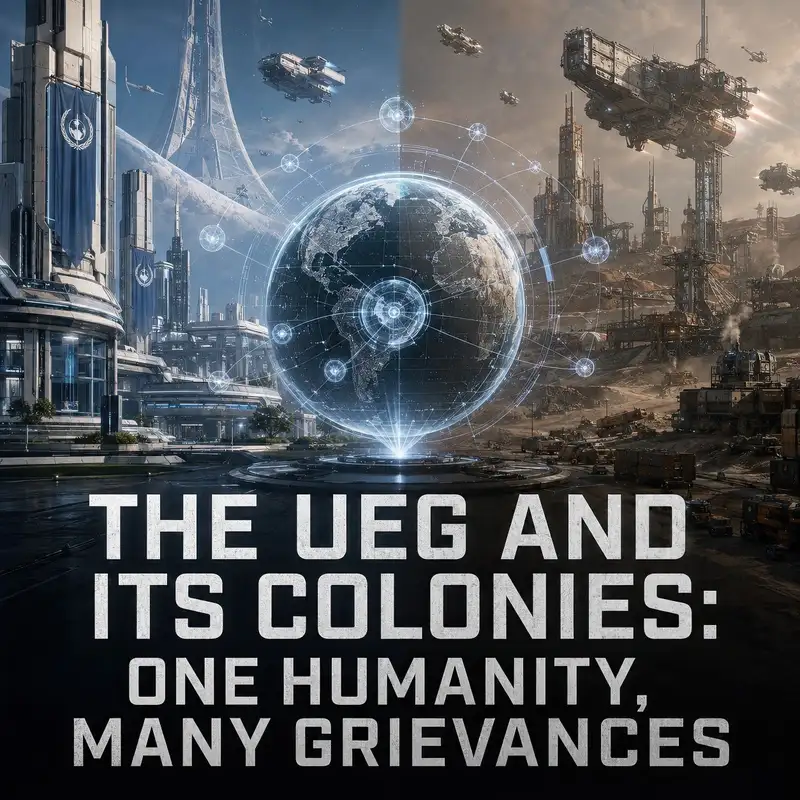
The UEG and Its Colonies: One Humanity, Many Grievances
An order leaving Earth for an Outer Colony could be lawful, carefully drafted, and obsolete before the people affected by it ever read it. Slipspace made interstellar government possible, but it did not make distant worlds close. Local officials still faced emergencies with incomplete guidance. Merchants watched prices change while cargo remained in transit. Military commanders acted on intelligence assembled weeks or months earlier. Colonists were expected to recognize the authority of a government they rarely saw, except through taxes, regulations, inspectors, or armed personnel. The Unified Earth Government claimed to represent one human civilization. Distance turned that claim into a continuing negotiation.
The central problem was not whether humanity shared a species, a history, or an interest in survival. It was whether hundreds of communities, separated by difficult travel and unequal development, believed they belonged to the same political order. The government on Earth offered law, trade, infrastructure, migration, and collective defense. It also demanded revenue, obedience, strategic resources, and control over technologies that could threaten the wider state. Those benefits and demands were distributed unevenly. The result was an interstellar society that was unified on maps, deeply integrated economically, and increasingly divided over who made decisions and who carried the cost.
The Unified Earth Government emerged from an earlier age of human conflict. The Interplanetary War had brought ideological movements, national forces, and the United Nations Space Command into violent competition across Earth and the Solar System. When the fighting ended in the early twenty-second century, the victors faced famine, damaged economies, population pressure, and a large military establishment built for a war that had ended. A stronger central government promised stability. It could coordinate reconstruction, regulate activity beyond Earth, and prevent another conflict among rival human blocs. Unity was therefore born less from universal agreement than from exhaustion, necessity, and the military power to enforce the settlement.
For more than a century, that system governed a civilization still concentrated in the Solar System. The next transformation came from the Shaw-Fujikawa translight engine. Human ships could now enter slipspace and cross distances that conventional propulsion made politically meaningless. The technology did not offer instant movement, precise arrival, or effortless communication. It offered something more important: the possibility of sustained settlement beyond Sol. In twenty-three ten, the government created the Colonial Administration Authority and its military partner, the Colonial Military Administration. One would organize settlement and civil administration. The other would protect distant communities, police frontier space, and support the expansion that civilian planners were preparing.
The great outward movement began in twenty-three sixty-two. Nearly one hundred colony ships departed the vicinity of Luna, opening the period later called the Domus Diaspora. Vessels such as the Odyssey and the First Reverie carried colonists, equipment, prefabricated facilities, agricultural systems, and the machinery required to turn a landing site into a permanent society. Reach and Tribute in the Epsilon Eridani system became part of the first major wave. These were not expeditions that could simply call home when a generator failed. A colony required power, water, shelter, medicine, transport, environmental control, and enough industrial capacity to survive until the next ship arrived.
The earliest extrasolar settlements became the Inner Colonies. Their colonists had often passed demanding selection programs because interstellar transport remained expensive and failure could destroy an entire venture. Over time, these worlds developed dense infrastructure, manufacturing, research institutions, shipyards, and political influence. Reach became both a major population center and the principal military stronghold beyond Earth. Tribute developed extensive industry. Other Inner Colonies became vital nodes in a network that connected Earth to the growing human sphere. Their prosperity was real, but it also created a hierarchy. The older colonies possessed the capital, technology, and institutions that newer settlements needed.
The Outer Colonies followed as travel became more practical and the hunger for land, resources, food production, and economic opportunity pushed settlement farther outward. They were never one kind of place. Some were agricultural worlds. Some existed around mines, refineries, shipping routes, research projects, or corporate concessions. Some developed elected local governments. Others were effectively managed by companies that controlled employment, transport, utilities, and access to off-world markets. A few became prosperous. Many remained dependent on imported machinery and specialist labor. Their inhabitants included idealists, workers, entrepreneurs, refugees, political dissidents, and people who had simply accepted the only passage they could obtain.
The distinction between Inner and Outer Colonies was therefore economic and political as much as geographical. The core worlds had older infrastructure and stronger connections to Earth. The frontier worlds supplied raw materials, agricultural products, and room for continued growth. The Inner Colonies, in return, supplied advanced equipment, manufactured goods, investment, military support, and access to the wider transportation system. Neither region was truly self-sufficient. That interdependence could have supported a durable federation. It also meant that control over shipping, licensing, taxation, and trade could be used as political leverage. A regulation written as economic policy on Earth could feel like coercion on a world whose only export market depended on government-approved routes.
Officially, the Unified Earth Government was a representative political system composed of self-governing worlds. The Colonial Administration Authority maintained records, inspected infrastructure, managed population and employment programs, supported public health, and applied the Laws of Deep Space. It could provide power systems, technical expertise, legal arbitration, and emergency assistance to communities that could not survive alone. These services mattered. Many colonists used them, valued them, and had no interest in rebellion. The frontier was not abandoned by definition. Yet the same administrative system could appear paternalistic, inflexible, and poorly informed. A colony could be autonomous enough to manage its water system, but not autonomous enough to decide whether it remained inside the state.
The Colonial Military Administration initially gave that state a local face. Its personnel protected shipping, answered piracy, supported settlements, and served across regions the larger United Nations Space Command did not routinely patrol. Many of its members came from the colonies they defended. That gave the organization familiarity and, in some places, legitimacy that Earth-centered institutions lacked. It also created divided loyalties. As the United Nations Space Command expanded into the Inner Colonies, the colonial military was pushed increasingly toward the frontier. Its officers and crews could see the gap between official policy and local reality more clearly than administrators on Earth. Some became sympathetic to separatist movements. A few actively aided them.
This did not mean the colonial cause was unified or that every grievance pointed toward independence. Some worlds wanted lower taxes. Others wanted control over trade, courts, policing, or natural resources. Corporate colonies might resist Earth while their own workers resisted the corporation. Local leaders could demand sovereignty while relying on government protection against pirates or rival factions. Peaceful reformers, constitutional separatists, armed insurgents, smugglers, and terrorists occupied the same political landscape without sharing one program. The word Insurrection would eventually compress these differences into a convenient military category. That made operations easier to brief. It did not make the underlying conflict simpler.
The government had reasons to fear fragmentation. The Outer Colonies were not isolated villages with no strategic value. They fed industrial populations, supplied critical materials, maintained shipping infrastructure, and occupied routes that connected the human sphere. An independent world might redirect commerce, shelter armed groups, or transfer slipspace components and nuclear material to actors hostile to the Unified Earth Government. A cascade of secessions could break the economy that sustained both the core and the frontier. From Earth, maintaining unity looked like the defense of civilization. From many colonies, it looked like Earth declaring that their resources were too important for their consent to matter.
By the late twenty-fifth century, political disputes were becoming security problems. Uprisings between twenty-four seventy-five and twenty-four eighty-three were met with severe colonial military responses. Repression hardened resistance, and resistance justified further deployments. In twenty-four eighty-seven, the People's Occupation and the Secessionist Union submitted formal demands for sovereignty on behalf of several worlds. The government refused. That decision did not create every later insurgent, but it strengthened the argument that lawful separation would never be permitted. Once peaceful political action appeared futile, armed factions could present violence as the only remaining instrument. Governments often discover this danger after helping to create it.
The next escalation revealed how far the state was prepared to go. In twenty-four ninety-two, rebellion on Far Isle resisted conventional suppression. The United Nations Space Command used nuclear weapons against the colony and left no known survivors. The surviving record does not provide a detailed public accounting of the decision, the target process, or the alternatives considered. The outcome is not uncertain. An entire human community was destroyed by the military created to defend human civilization. Far Isle became proof, for separatists and frightened civilians alike, that the language of unity could conceal a willingness to eliminate those who rejected it.
Insurgent violence produced its own evidence. Armed groups attacked government facilities, military personnel, commercial traffic, and civilian targets. Some obtained nuclear weapons. Some assassinated officials or used populations as cover. Their decentralized structure made negotiation difficult because no agreement with one organization bound the others. It also made intelligence uncertain. A peaceful autonomy movement and a cell preparing mass-casualty attacks might operate on the same world, draw on similar grievances, and despise one another. Military forces trained to locate threats often treated the shared environment as evidence of shared guilt. Insurgents then used every raid, detention, and civilian death as recruitment material.
The Callisto Incident in twenty-four ninety-four turned this cycle into a wider naval conflict. A confrontation involving the inspection of colonial shipping led to bloodshed, the seizure of the corvette Callisto, and the death of its crew. The government responded with blockades, searches, and warships. The insurgents demonstrated that they could capture military technology and defeat a stronger force through planning, deception, and the intelligent use of local terrain. The United Nations Space Command learned that frontier policing had become maritime counterinsurgency. Every merchant vessel could carry legitimate cargo, contraband, weapons, or intelligence. Every inspection could protect the state or produce the next rebellion.
The crisis also damaged the Colonial Military Administration. Investigations exposed separatist agents inside senior colonial military offices. To central authorities, this confirmed that the organization responsible for frontier security had been compromised. Its duties, personnel, and resources were progressively absorbed by the United Nations Space Command. The transfer may have improved centralized control, but it removed an institution many colonists considered their own and replaced it with one more closely identified with Earth. A security reform intended to restore trust at the center reduced trust on the frontier. The government gained a clearer chain of command and inherited a larger legitimacy problem.
Intelligence analysis then gave coercion the appearance of mathematical necessity. The Carver Findings warned that unrest could escalate into catastrophic civil war. Critics argued that patient diplomacy might stabilize relations, but military planners could not ignore projections of systemic collapse. Programs were revived or created to remove insurgent leadership, penetrate organizations, and prevent rebellion from spreading. The logic was understandable. If a small number of actors could ignite war across hundreds of settlements, targeted force seemed preferable to mass mobilization. The danger was that prediction became policy. Once leaders accepted that rebellion was inevitable, every grievance looked like confirmation and every demand for autonomy looked like preparation for war.
Operation TREBUCHET, launched in twenty-five thirteen, became the broad military answer. Navy ships, Marines, intelligence units, and special operators conducted campaigns across multiple systems. They pursued armed organizations, secured installations, intercepted shipping, raided bases, and attempted to sever insurgent networks. Some operations prevented attacks and removed dangerous leaders. Others caused civilian deaths, destroyed local infrastructure, or deepened hostility toward the government. The campaign grew because the political objective remained larger than any tactical success. Capturing a cell did not make taxation legitimate. Destroying a base did not create representation. Securing a port did not persuade its workers that Earth understood their interests.
This was the strategic limit of the government's approach. Military power could keep routes open, protect facilities, and deny insurgents open control of major worlds. It could not compel a population to regard distant authority as rightful. Nor could insurgent violence create a stable alternative simply by making government expensive. Separatist factions lacked unified leadership, common institutions, and a shared plan for trade, defense, and relations among independent colonies. Each side could disrupt the other more easily than it could build a durable peace. The Unified Earth Government retained superior resources. The insurgents retained the political advantage of being local, dispersed, and difficult to eliminate.
Ordinary colonists lived inside that contradiction. A farmer might depend on Inner Colony machinery, sell crops through regulated shipping, resent export controls, and still want naval protection. A dockworker might oppose the government without supporting bombings. A Colonial Administration Authority technician might keep a settlement alive while being treated as an agent of occupation. A Marine might believe a raid prevented an attack and later learn that the intelligence was incomplete. Families could contain government employees, militia members, smugglers, and separatist sympathizers at the same table. The civil conflict was not a clean line between Earth and the frontier. It ran through communities and institutions.
Then, in twenty-five twenty-five, the Covenant attacked Harvest. The first known target of the alien war was an Outer Colony whose economy depended on agriculture and interstellar freight. Humanity's internal struggle did not disappear, but its strategic scale changed overnight. A government accused of overmilitarizing the frontier now faced an enemy that intended extermination rather than political control. Some insurgents cooperated with the United Nations Space Command. Others maintained neutrality, protected only their own communities, or continued fighting the state. Shared danger produced temporary alliances. It did not erase memory, ideology, or distrust.
The Covenant advance also exposed the unequal geography of human defense. Outer Colonies were struck first and often defended with whatever forces happened to be available. Fleets could not be everywhere, and destroyed worlds could not be replaced. As losses mounted, the military concentrated surviving strength around Inner Colonies, industrial centers, Reach, and eventually Earth. Strategically, the decision was difficult to avoid. Industrial capacity and command infrastructure had to be preserved if the war was to continue. Politically, it confirmed the oldest colonial accusation: the frontier supplied the system, but the core received priority when survival was rationed.
Emergency conditions shifted governing authority toward the United Nations Space Command. Civilian administration weakened as communications failed, colonies fell, and military commanders made decisions faster than distant institutions could review them. The Unified Earth Government remained the source of lawful authority, but the armed forces increasingly performed the functions of government. The organization once deployed to suppress colonial revolt became the principal structure holding humanity together. That was not vindication of every prewar policy. It was evidence that institutions can be simultaneously necessary, effective, abusive, and distrusted.
The war destroyed much of the colonial system that had generated the conflict. Agricultural worlds burned. Trade routes vanished. Populations fled toward already strained settlements. Governments lost contact with their constituents. Local defense forces fought without reinforcement. The destruction of Reach demonstrated that Inner Colony status offered importance, not immunity. The attack on Earth proved that the core itself could be reached. By the time the Covenant collapsed in twenty-five fifty-two, humanity had survived, but the old economic relationship among Earth, the Inner Colonies, and the Outer Colonies had been shattered.
Survival did not settle the constitutional question. Civilian authority returned, reconstruction began, and surviving colonies reconsidered what they owed a government that had been unable to protect them. From Earth's perspective, the military had sacrificed ships, personnel, and entire formations for worlds across human space. From the frontier, many communities remembered delayed warnings, inadequate defenses, forced requisitions, or years of abandonment. Both accounts could be true. A state can spend itself defending its citizens and still fail to distribute protection equally. A colony can receive genuine assistance and still conclude that independence offers greater dignity or control.
The Unified Earth Government's greatest achievement was that it made an interstellar human civilization possible. It organized colonization, maintained common systems, supported movement between worlds, created institutions for law and public health, and provided military power no individual colony could have built alone. Its failure was assuming that integration would naturally become allegiance. Economic dependence was not the same as consent. Administrative reach was not the same as representation. Military presence was not the same as legitimacy. The government could connect worlds faster than it could persuade them that the connection was fair.
That is why one humanity produced so many grievances. The colonies were not rejecting their species or denying the value of collective defense. They were arguing over the terms of belonging: who governed, who benefited, who was protected, and who could leave. Earth saw a network whose survival required unity. Many colonists saw a hierarchy that called dependence cooperation and resistance disorder. The Covenant War proved that humanity needed common institutions. It also proved that necessity did not cleanse those institutions of their earlier choices.
On a strategic map, the Unified Earth Government appeared as lines connecting Earth to hundreds of distant settlements. Along those lines moved settlers, food, ore, machines, taxes, orders, soldiers, and distress calls. They did not move at the same speed, and they did not carry equal weight. The government endured because the network was real. The grievances endured because the relationship was unequal. Humanity had built an interstellar state before it had built an interstellar political community, and every later war inherited the consequences of that unfinished work.