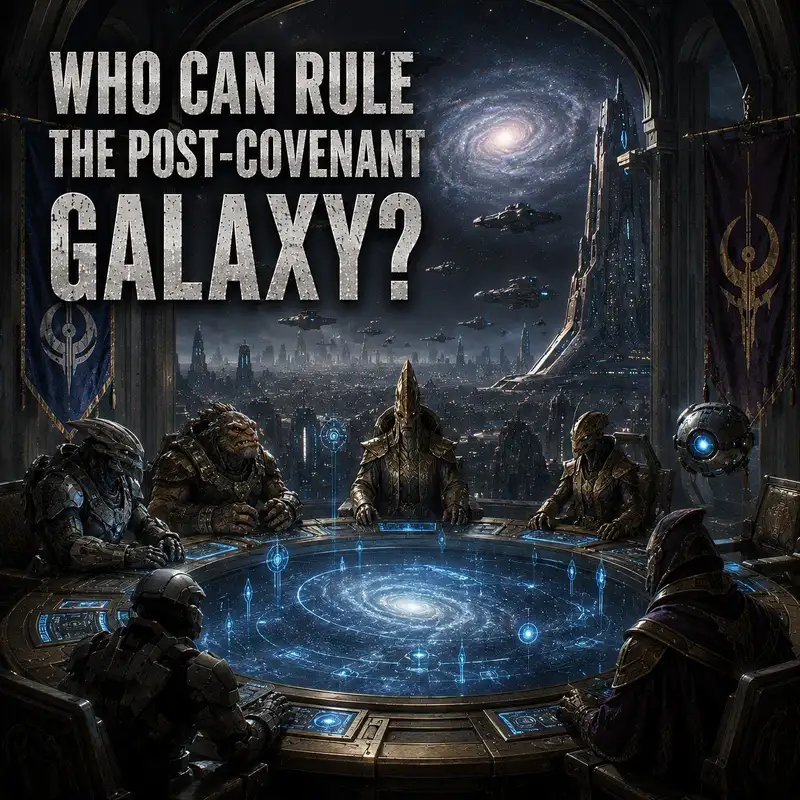
Who Can Rule the Post-Covenant Galaxy?
Shipmistress Mahkee ‘Chava had a Banished dreadnought in front of her and orders not to attack it. Ghost of Barolon outgunned her blockade runner, while Banished forces were already moving against the crystal mines of Suban below. Mahkee’s task was to remain outside the enemy’s strongest firing envelope, use a recovered Forerunner hyperscanner, and find a weakness for the Swords of Sanghelios and their Spartan allies to exploit. Courage was available. Tonnage was not.
That engagement in early twenty-five sixty reduced the post-Covenant balance of power to one tactical display. The Banished possessed the heavier ship and the initiative. The Swords of Sanghelios possessed local legitimacy, intelligence, and defenders fighting for their own territory. Humanity could contribute Spartans and specialized support, but not a fleet large enough to solve the campaign alone. No participant controlled every requirement for victory. The same was true across the wider interstellar order.
The question of who can rule the post-Covenant galaxy is therefore not answered by identifying the largest weapon. Rule requires at least five things: force able to deter challengers, industry able to replace losses, communications and logistics able to connect distant systems, institutions able to survive one leader, and enough legitimacy that every disagreement does not become an insurgency. Several powers possess two or three. None possesses all five.
The old Covenant had come closer than any of its successors. High Charity connected religious authority, ministries, fleets, archives, industry, and species hierarchy in one mobile capital. San’Shyuum doctrine gave military orders sacred meaning. Sangheili commanders provided professional force. Client species supplied labor, trade, technical skill, and manpower. The arrangement was unequal and often brutal, but it could move resources across a vast empire and make billions of subjects recognize one political center.
Its collapse in twenty-five fifty-two divided those functions among survivors who could not easily recombine them. Sangheili inherited ships without universally accepted government. Jiralhanae packs inherited weapons without the imperial supply system. Kig-Yar captains retained trade networks but little interest in administering other species. Unggoy populations gained new political choices while remaining economically vulnerable. San’Shyuum survivors retained knowledge and old claims without the military partnership that had enforced them. The Covenant did not leave an empty throne. It left the throne in pieces.
The loss of High Charity also changed the economics of power. A surviving commander might inherit a carrier, but not the workshops, tithe routes, Huragok, fuel depots, and replacement crews that had kept it operational. Worlds once connected through imperial distribution became regional economies with different currencies, technical standards, and security arrangements. The first post-Covenant ruler therefore needed to do more than capture the old fleet. It needed to rebuild the system that allowed the fleet to leave port twice.
Cortana attempted to solve that fragmentation through overwhelming strategic control. Guardians could disable fleets, cities, communications, and power grids before conventional governments organized resistance. Artificial intelligences already embedded inside human infrastructure supplied access and administration. For a little more than a year, the Created demonstrated that one power could impose compliance across several civilizations without building an occupation army large enough to stand on every street.
The method failed because compliance was not consent and because the system depended too heavily on Cortana herself. Guardians deterred open war, but they did not reconcile colonial grievances, Sangheili keep politics, Jiralhanae resistance, or organic fear of machine rule. When Cortana died at Zeta Halo and the Guardians deactivated, the empire lost its central commander, principal deterrent, and common political direction together. A government designed around one irreplaceable mind had neglected the mildly inconvenient possibility that the mind might become unavailable.
Created remnants still matter. High Auxiliary Sloan has pursued new forms of artificial life, including the Executor project, while aligned intelligences retain access to Promethean systems and at least one enormous Forerunner vessel. Their practical ability to use that vessel approaches only a fraction of its original potential, and the Domain is no longer freely available to them. The Created can infiltrate, sabotage, and hold isolated assets. They no longer possess the unified coercive network required to police the known galaxy.
The Banished are the strongest candidate if rule is measured first by the ability to seize territory. They survived Covenant retaliation, absorbed ships and clans after the Great Schism, built mobile industrial capacity, and learned to turn every battlefield into a source of replacement equipment. Their dreadnoughts carry troops, extraction machinery, workshops, vehicles, and prefabricated bases. A Banished fleet does not merely arrive above a target. It brings enough of a war economy to begin converting the target immediately.
Their organization is also resilient. Atriox created a confederacy in which packs, mercenaries, shipmasters, workshops, and client forces retain internal identity while serving wider objectives. The loss of one base or commander does not automatically end the network. After Atriox disappeared from open command at Zeta Halo and Escharum died, other leaders continued fighting. War Chief Severan commanded major Banished fleets that had remained in the galaxy and became, in practical terms, the organization’s most visible external leader.
That distribution allows simultaneous campaigns. Banished forces remained active on the Ark, occupied large sections of Zeta Halo, moved against Suban, supported allied human separatists, and pursued Forerunner infrastructure elsewhere. Their workshops combine Jiralhanae engineering with Covenant salvage, Kig-Yar commerce, human technology, and whatever ancient systems can be forced into service. They possess strategic mobility, a replacement system, and commanders accustomed to operating without one central ministry.
The same structure limits their ability to govern. Banished loyalty rests on victory, reward, personal authority, and fear more than public law. Clans cooperate while the confederacy distributes spoils and worthy campaigns. Mercenaries reconsider service when the bargain changes. Subject populations receive little assurance that Banished freedom applies to anyone too weak to negotiate. The organization can conquer a mine, spaceport, or ring sector. Administering generations of civilians who do not want to be Banished is a different campaign with worse opportunities for dramatic hammer use.
Zeta Halo displays both sides of the problem. The Banished defeated the United Nations Space Command Infinity, built outposts, captured survivors, and controlled large regions for months. After Escharum’s death, local leadership entered disorder. Atriox remained alive but absent from the visible chain of command, while commanders pursued revenge, survival, and personal standing. The Banished still held substantial force. They lacked a stable political authority capable of converting occupation into uncontested rule over the installation.
Severan’s position illustrates the Banished succession problem. He commands fleets, possesses a powerful flagship, and can direct campaigns while Atriox is absent. That gives the organization continuity. It does not establish an accepted constitutional transfer of authority. If Atriox returns openly, Severan’s power may remain delegated. If Atriox does not, every major war chief must decide whether service to the Banished means service to its founder, its current commander, or the clan strongest enough to settle the distinction.
The Unified Earth Government and the United Nations Space Command possess the opposite strengths. Their surviving institutions know how to administer populations, maintain law, train personnel, operate shipyards, collect intelligence, and coordinate civilian and military systems. Humanity retains colonies, industrial worlds, corporations, local governments, logistics organizations, and a legal framework older than the Covenant War. No alien faction possesses an equivalent claim to govern human space.
That framework has been badly damaged. Earth’s command system was disrupted by the Created. The Infinity was ambushed and evacuated. Communications among surviving forces became unreliable, artificial-intelligence support became politically suspect, and numerous colonies had to act without current guidance. Humanity’s most advanced ship could not serve as a government while missing, damaged, or scattered across an unknown ring. Flagships remain useful political symbols, but symbols are difficult to dock for repairs.
Continuity survived through distributed leadership. Fleet Admiral Terrence Hood and Admiral Serin Osman escaped Created control and rejoined human forces. Captain Thomas Lasky, Commander Sarah Palmer, Doctor Catherine Halsey, Spartans, Marines, pilots, and other Infinity survivors continued rebuilding resistance on Zeta Halo. The Master Chief and Joyeuse disrupted Banished command and searched for isolated personnel. Human military power was fragmented, not erased.
Fragmentation still imposes strategic limits. The United Nations Space Command cannot defend every colony, rebuild every lost fleet, suppress every separatist movement, and contest every Forerunner site at the same time. Shipyards require secure systems, rare material, trained workers, and years of production. Colonial governments remember earlier repression and wartime abandonment. A human administration can claim legal authority over human colonies. It has neither the legitimacy nor the manpower to govern Sangheili keeps, Jiralhanae packs, Kig-Yar markets, or Unggoy communities.
That limitation is politically healthy when recognized and disastrous when concealed. The Office of Naval Intelligence previously tried to preserve human security by prolonging Sangheili civil war, arming the Arbiter’s enemies while diplomats built an alliance with him. Such operations may weaken a potential rival in the short term. They also teach every ally that human promises come with a classified second version. Humanity can help shape a post-Covenant order. It cannot lead one durably if covert manipulation makes partnership indistinguishable from preparation for betrayal.
The Swords of Sanghelios possess the strongest claim to legitimate regional government outside human space. Thel ‘Vadam built the alliance from keeps, fleets, and commanders that chose common action after the Covenant’s collapse. The Swords defend Sanghelios, negotiate with humanity, reform military service, and rebuild industry without claiming that the Prophets’ old authority has simply transferred to the Arbiter.
Their legitimacy remains limited by Sangheili political tradition. Thel is not emperor of every keep or colony. Some Sangheili support Covenant remnants, some serve the Banished, and others reject every larger faction. Kaidons retain land, warriors, and local authority. The Swords can coordinate those willing to participate, but cannot erase opposition without reproducing the coercive system they were created to replace. Their political strength comes partly from not pretending every Sangheili has already agreed.
Militarily, Suban exposed the cost. Scorrin’s Blade possessed stealth, advanced sensors, disciplined leadership, and a crew drawing talent from roles the old Covenant had restricted. It still could not exchange fire evenly with Ghost of Barolon. Many Swords vessels descend from older patterns, while Banished dreadnoughts represent a rapidly expanding industrial power. The Swords can defend home territory, conduct joint operations, and win through intelligence and precision. They do not possess uncontested naval dominance even inside the Urs system.
Their alliance with humanity compensates for part of that weakness. Anvil Station survived the Created crisis and continued operating in March twenty-five sixty, staffed by human and Sangheili personnel trained to work across former enemy institutions. The Riftborn pair specialists from both species for reconnaissance, sabotage, intelligence, and other missions. Spartan attachés support Swords operations under an ongoing treaty. These arrangements are small compared with the Covenant’s old military machine, but they create something the empire rarely possessed: cooperation not formally based on species caste.
Thel’s proposed Concert of Worlds is therefore the most serious model for a durable wider order, but it remains a proposal rather than a functioning galactic government. The Swords would be one member of a broader multispecies alliance, not the ruler of every participant. Human governments, Sangheili keeps, Unggoy communities, independent colonies, and other polities would retain local authority while coordinating defense and diplomacy. The design exchanges imperial speed for consent, which is less impressive during a parade and more useful after the soldiers go home.
Other former Covenant peoples complicate the project further. Balaho accepted Created assistance when other powers failed to provide food, medicine, and industrial recovery. Kig-Yar clans prefer contracts and local autonomy to distant administration. Jiralhanae survivors have lost their homeworld but not their competing pack loyalties. Lekgolo, Yanme’e, Huragok, and fringe communities possess political interests outsiders only partly understand. A multispecies order cannot treat these populations as supporting units waiting for assignment. The Covenant tried that method for millennia and eventually received a rather comprehensive performance review.
The model faces severe obstacles. Members must share intelligence without surrendering every secret, coordinate fleets without creating one dominant command, and establish rules for Forerunner technology before someone finds another device capable of ending the discussion permanently. Human and Sangheili veterans must cooperate while remembering who burned which worlds. Independent colonies must believe collective defense will not become renewed central control. A concert can survive disagreement only if its members possess institutions for resolving disagreement before a war chief offers a faster method.
Covenant successor groups cannot presently fill that role. Jul ‘Mdama’s Covenant collapsed after concentrating authority around one leader and borrowed Forerunner legitimacy. The Servants of the Abiding Truth preserve belief and networks but lack broad military and industrial reach. The Keepers of the One Freedom survived in cells after Castor’s break with the faith, yet remain an insurgent current rather than a governing system. These movements can destabilize regions, recruit the alienated, and seize ancient sites. None can restore the administrative machinery of High Charity.
The Order of Restoration presents a more disciplined danger. High Lord Dovo Nesto retains San’Shyuum networks, Prelates, hidden resources, and a stated plan connected to Cloister. Such a faction could recover technology, sponsor proxies, or claim religious continuity. It still faces the problem every San’Shyuum restoration must solve. The species once ruled through Sangheili fleets and a covenant accepted across many worlds. Secret archives and elite guards can preserve a court. They do not automatically provide an empire willing to obey it.
Independent worlds and underworld markets are not candidates for galactic rule, but they can prevent others from monopolizing power. Venezia, Gao, Kig-Yar clearing houses, smugglers, salvagers, and colonial militias move weapons, information, specialists, and ships outside formal alliances. Their networks let small factions acquire capabilities once controlled by states. They can keep isolated communities alive and arm organizations that should never have reached orbit. Either result weakens any government attempting to control trade through one border system.
The Xalanyn are an even larger uncertainty. Their survival of the Halo Array and Forerunner imprisonment make them strategically important, while the Harbinger’s campaign proved that at least some could operate advanced systems and command Gasgira forces. Atriox reached their cylixes, but the current number, condition, organization, and intentions of the Endless remain unresolved. They may become a major power. Present evidence does not support assigning them a fleet, government, or galactic program simply because the Forerunners feared them.
Forerunner technology will continue creating temporary kingmakers. A Guardian, Halo installation, Domain gateway, Composer, or hidden fleet can give one faction leverage far beyond its industrial base. That leverage rarely includes reliable understanding, maintenance, succession, or political legitimacy. Cortana possessed the Guardians and still lost control. Jul possessed Prometheans and lost them to a higher authority. Atriox reached Xalanyn prisons without proving he could command those released. Finding the throne’s control panel is not the same as governing everyone in the room.
The Flood represents the final limit on the language of rule. A Gravemind can coordinate fleets, manipulate enemies, absorb intelligence, and use captured infrastructure more efficiently than many governments. It does not govern populations as political communities. It converts them into itself. Any faction that releases the Flood while competing for power may end the contest by eliminating every contestant. Containment therefore remains one of the few interests all surviving civilizations share, though shared interests have not always prevented someone from opening the sealed door.
For civilians, the difference between a ruler and a raider is measured through ordinary services. Can transports move without paying several armed groups? Can a city restore power without accepting political surveillance? Can a colony appeal a military requisition, receive medical aid, and expect the same agreement to remain valid after the admiral or kaidon dies? A faction able to win battles but unable to answer those questions may dominate territory. It has not yet built a state.
No current power can rule the post-Covenant galaxy alone. The Banished possess the strongest expansionist military network but not universal legitimacy or settled succession. Humanity possesses the deepest surviving administrative tradition and substantial industry, but lacks the force and consent to govern beyond human space. The Swords of Sanghelios possess regional legitimacy and an emerging coalition model, but not the naval weight to dominate their rivals. Created remnants, Covenant restorers, and the Endless possess dangerous capabilities without a proven governing order.
The likely future is regional and contested. Human authorities will try to reconnect colonies. The Swords will defend Sanghelios and expand selected partnerships. Banished war chiefs will seize resources, transport routes, and ancient systems wherever opportunity permits. Independent markets will connect enemies who officially refuse contact. Artificial intelligences will build new political identities. Every major power will seek enough Forerunner technology to deter the others while insisting that its own access is responsible and everyone else’s is an emergency.
Durable order will depend less on who can seize the most powerful relic than on who can make alliances survive a defeat, a leadership change, and an intelligence failure. That favors institutions such as Anvil and the proposed Concert of Worlds over another sacred empire or machine dictatorship. It does not guarantee their success. Coalition government asks participants to accept slower decisions, shared credit, and limits on unilateral power, three requirements military victors traditionally discover only after attempting all available alternatives.
Above Suban, Mahkee ‘Chava did not rule the battlefield. She lacked the largest ship, could not command the human Spartans below, and did not control every keep whose future depended on the battle. She could gather intelligence, coordinate allies, preserve her force, and create an opportunity none of them possessed alone. That is the closest answer the post-Covenant galaxy currently offers. No one can rule it securely. The power most likely to shape it is the coalition capable of winning without demanding that every survivor become a subject.